
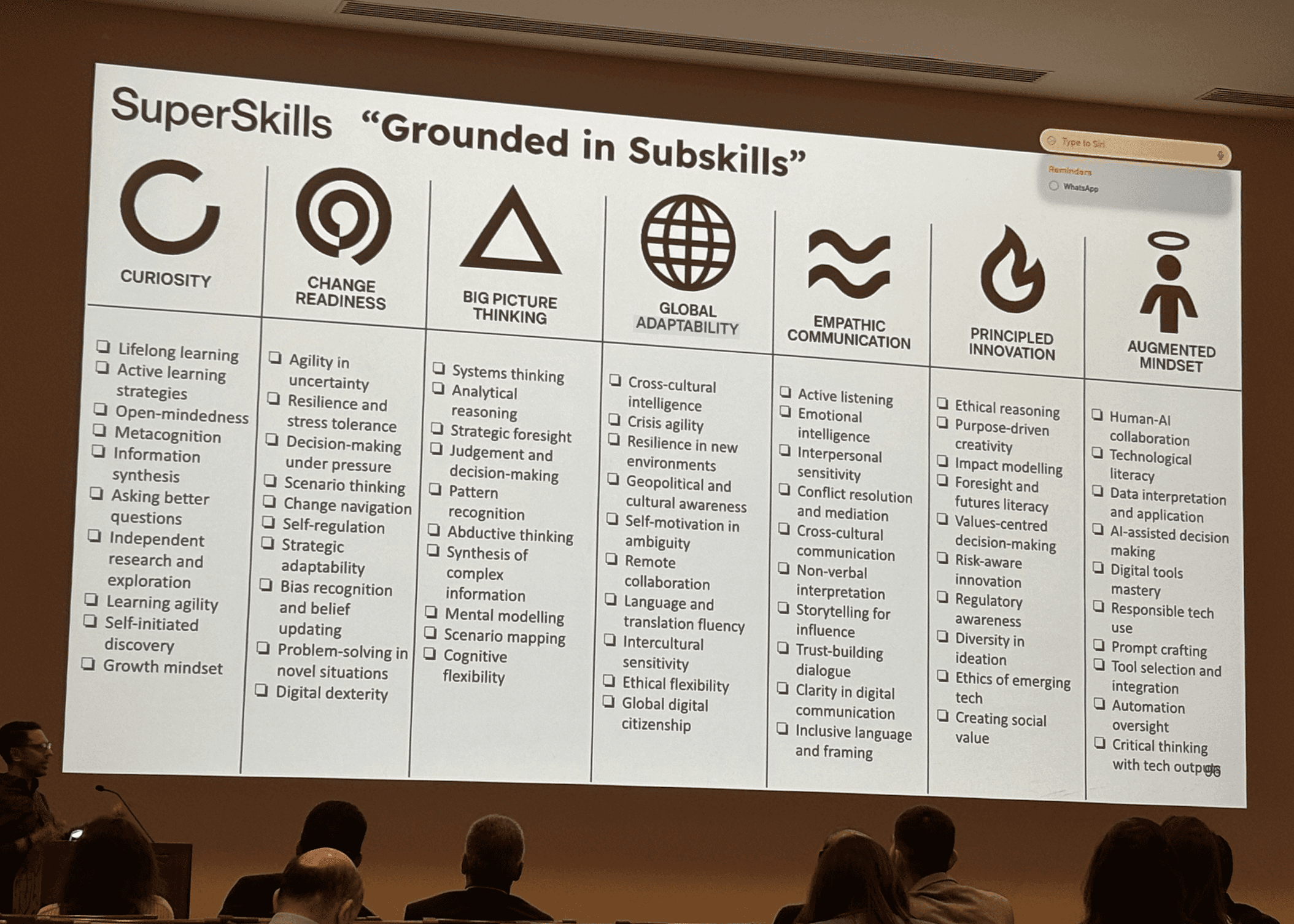
Introduction to the SuperSkills by Rahim Hirji
The World That Made SuperSkills Inevitable
Something has shifted in the architecture of professional life, and most people can feel it even if they cannot name it.
The symptoms are everywhere. A mid-career professional watches their expertise become commoditised by tools that did not exist three years ago. A recent graduate discovers that the role they trained for has been restructured before they could fill it. A senior leader makes decisions at speeds that outpace their organisation's capacity to learn from outcomes. An entire industry watches its competitive dynamics reorder in months rather than decades.
These are not isolated disruptions. They are signals of a deeper transformation in the relationship between human capability and technological power.
For most of the last century, progress followed a recognisable pattern. New technologies arrived. Work shifted. Education adapted. Skills remained stable long enough that people could plan careers, organisations could plan workforces, and societies could plan institutions. The pace of change was fast enough to matter but slow enough to manage.
That rhythm has broken.
Since 2020, three forces have collided with accelerating intensity. Computational power has advanced faster than organisational learning can absorb. Artificial intelligence has crossed from narrow automation into general cognitive assistance, touching every knowledge profession simultaneously. Global systems have become more fragile precisely as decision velocity has increased, creating environments where the cost of poor judgment compounds faster than ever.
The result is a mismatch between how humans have traditionally developed capability and how work now evolves. Roles unbundle faster than people can retrain. Early-career learning opportunities disappear as automation absorbs the tasks that once built expertise. Senior leaders make high-stakes decisions with shrinking feedback loops. Organisations invest heavily in tools while quietly eroding the judgment, context, and resilience that make those tools valuable.
This is the world that made SuperSkills inevitable.
The Scarcity That Now Matters
When technology absorbs tasks, the scarce value shifts. What becomes precious is not what machines can do but what they cannot. Not what can be automated but what requires human presence to function. Not what scales through computation but what scales through trust, judgment, and adaptive intelligence.
The printing press eliminated scribes while making authorship more consequential. Calculators eliminated arithmetic while making mathematical thinking more powerful. Each wave of automation absorbed the routine and elevated the distinctive.
The current wave is different in scale but not in kind. Artificial intelligence is absorbing cognitive tasks across every knowledge domain simultaneously. Research, analysis, drafting, coding, summarising, translating. Tasks that once required significant training can now be performed rapidly by systems available to anyone.
The response to this shift divides into two paths. One leads to drift: passive acceptance of whatever the technology enables, gradual erosion of human capability, increasing dependence on systems that are not understood. The other leads to design: deliberate development of the capacities that govern how humans work with powerful tools and maintain agency in complex systems.
SuperSkills exist on the second path.
What Makes a SuperSkill
The term skill has become so overused that it has lost precision. Job descriptions list dozens. Training catalogues offer hundreds. The implication is that capability is simply a matter of accumulation, that more skills means more value.
That logic fails under conditions of rapid change.
Most skills are context-dependent. They work in specific roles, industries, or technological environments. When those contexts shift, the skills depreciate. A particular software proficiency, a specific process expertise, a narrow domain knowledge. These have value, but they do not compound. They erode.
SuperSkills operate differently. They are meta-capabilities that sit above roles, industries, and tools. They govern how someone learns new skills, adapts to new contexts, makes decisions under uncertainty, builds trust across difference, and works with systems that are more capable than any previous generation has encountered.
The distinction matters because in many fields, technical tool proficiency now turns over within a few years. What someone learns at the start of a career may be substantially obsolete before they reach mid-level.
SuperSkills solve this problem by sitting upstream. They are the capabilities that enable the rapid acquisition of new skills, the navigation of unfamiliar contexts, and the maintenance of effectiveness as everything downstream changes. They do not replace domain expertise. They make domain expertise renewable.
Four criteria distinguish SuperSkills from ordinary skills.
First, durability. A SuperSkill must retain value across at least two major technological cycles. Skills tied to specific tools, platforms, or processes fail this test. Meta-capabilities that govern how humans think, decide, and relate pass it. Curiosity was valuable before the internet and will be valuable after whatever comes next. Change readiness mattered during industrialisation and will matter through whatever transformations follow.
Second, transferability. A SuperSkill must apply across industries, cultures, and stages of life. A capability that only works in one context creates fragility rather than strength. The ability to see systems and second-order effects is as valuable in healthcare as in finance, as relevant in Lagos as in London, as important at twenty-five as at fifty-five.
Third, AI interaction. A SuperSkill must either govern how humans work with intelligent systems or protect against the predictable failure modes that automation creates. Judgment decay, over-reliance, ethical drift, skill atrophy. These are not hypothetical risks. They are documented patterns that appear whenever humans cede cognitive work to machines without maintaining active engagement.
Fourth, compounding effect. A SuperSkill must amplify the effectiveness of other capabilities over time. The goal is not competence at a single point. The goal is a trajectory where each year of development increases capacity rather than merely maintaining it. Skills that compound create durable advantage. Skills that do not compound create temporary adequacy.
Many popular skills fall away under this lens. Creativity without judgment collapses into noise. Technical fluency without ethics scales harm. Resilience without direction becomes endurance theatre. Communication without empathy becomes manipulation.
The seven SuperSkills that remain form a coherent system. Each addresses a distinct dimension of human capability that becomes more valuable as machines become more powerful. Together, they define what it means to be capable in an AI-shaped world.
The Seven SuperSkills
Curiosity is the disciplined drive to explore, learn, and update beliefs in the face of new evidence. It is not passive openness but active pursuit. Research consistently shows that curiosity predicts learning outcomes, creative achievement, and career longevity independent of intelligence. In an environment where knowledge expires faster than ever, the disposition to keep learning is not optional. It is foundational.
Change Readiness is the capacity to maintain effectiveness while adapting to altered circumstances. It differs from resilience, which emphasises recovery, and from optimism, which emphasises attitude. Change readiness involves cognitive flexibility, proactive adjustment, and the ability to function under sustained uncertainty without paralysis or rigidity. As transformation becomes continuous rather than episodic, this capacity determines who navigates successfully and who is perpetually destabilised.
Big Picture Thinking is the ability to grasp system interdependencies, long-term patterns, and second-order effects. It enables judgment when local optimisation fails, when immediate actions produce delayed consequences, when the frame that defines a problem determines the quality of solutions. In a world of increasing complexity and interconnection, those who cannot see beyond their immediate domain make decisions that solve one problem while creating others.
Empathy is the capacity to understand and respond to others' inner experience while maintaining the distinction between self and other. It is not sentiment. It is the foundation of trust, collaboration, and influence. Research links empathy to leadership effectiveness, team performance, and stakeholder outcomes across sectors. As work becomes more distributed and mediated by technology, the ability to perceive what others are thinking and feeling becomes more consequential, not less.
Global Adaptability is the capacity to function effectively across diverse cultural and situational contexts by adjusting approach without losing core identity. It combines cognitive flexibility, cultural intelligence, and behavioural agility. In a world shaped by migration, remote collaboration, and geopolitical complexity, the ability to operate beyond one's native context is no longer a specialist skill. It is a baseline requirement for consequential work.
Principled Innovation is the practice of creating progress under explicit ethical constraint. It rejects the assumption that innovation and responsibility are trade-offs. It integrates foresight, stakeholder consideration, and value alignment into the creative process rather than treating them as afterthoughts. As the power of new technologies increases, the consequences of unprincipled innovation become more severe. Those who cannot innovate responsibly will find their innovations rejected, regulated, or reviled.
The Augmented Mindset is the capacity to partner with AI and intelligent tools to extend cognitive capability without surrendering judgment or accountability. It involves knowing when to delegate to machines and when to retain human control, how to evaluate algorithmic outputs, and how to maintain the skills that make human contribution valuable.
This is the culminating SuperSkill because it is where all others become operational. The augmented mindset without curiosity stagnates. Without change readiness, it calcifies around tools that will soon be obsolete. Without big picture thinking, it optimises within frames that should be questioned. Without empathy, it produces work that erodes trust. Without global adaptability, it assumes one context applies everywhere. Without principled innovation, it scales capability and harm together.
Remove any one of the seven, and the system fails in predictable ways. A professional with every SuperSkill except empathy becomes technically effective but relationally corrosive. An organisation with every SuperSkill except principled innovation scales its capabilities and its harms together. A leader with every SuperSkill except big picture thinking optimises brilliantly within a frame that should have been questioned.
These seven are not an arbitrary selection. They are the minimum viable set for remaining effective, ethical, and adaptive in a world where intelligent systems handle increasing shares of cognitive work.
The Transformation Underway
The scale of change now in motion exceeds what most institutions have internalised.
McKinsey & Company estimates that up to 30 percent of hours worked in advanced economies could be automated by the early 2030s. The World Economic Forum reports that meta-capabilities like analytical reasoning, resilience, and social influence are rising in importance faster than technical skills as routine cognitive tasks decline.
But the statistics miss the texture of what is actually happening.
Consider the experience of a young professional entering a field where AI can now perform entry-level tasks at acceptable quality. The traditional path, building expertise through repetition, developing judgment through consequence, is disrupted before it begins. The rungs that previous generations climbed are missing.
This is the Missing Rungs problem. AI absorbs the tasks that once served as training grounds. Junior lawyers who never reviewed thousands of documents cannot spot the anomaly that matters. Junior analysts who never built models from scratch cannot evaluate the models that AI generates. Junior clinicians who never worked through differential diagnoses cannot recognise when the AI's suggestion does not fit.
The efficiency gain is real. So is the capability cost.
Or consider judgment decay. When humans work with AI systems that provide recommendations, the observed tendency is to accept. In controlled studies, radiologists have deferred to AI assessments even when those assessments were wrong. Physicians have changed prescribing decisions based on AI suggestions, and in a measurable fraction of cases the change was from correct to incorrect. Pilots have shown loss of proficiency in cognitive flight skills after extended periods of heavy automation use.
The pattern is not that AI makes humans worse. It is that uncritical reliance on AI can make humans worse.
This is where SuperSkills become essential. They prevent drift into dependence. They maintain the engagement necessary for human-AI collaboration to work. They preserve the development of expertise even as automation absorbs tasks.
Why Human Distinctiveness Increases in Value
A common fear holds that AI advancement diminishes human value. As machines become more capable, humans become less necessary.
This fear mistakes the nature of the shift.
What AI advancement diminishes is the value of routine human cognition. Tasks that follow predictable patterns, that can be specified algorithmically, that require consistency rather than judgment.
What AI advancement increases is the value of distinctively human contribution. The judgment that determines whether an AI output is appropriate for a specific context. The empathy that builds trust in high-stakes relationships. The creativity that generates genuinely novel solutions. The ethics that govern whether a capability should be deployed.
The paradox is straightforward. The more powerful the tools, the more dangerous unskilled human oversight becomes. The more that AI can generate, the more consequential human judgment about what to use becomes.
Consider medicine. Diagnostic AI can match or exceed human accuracy on many imaging tasks. But outcomes depend on how clinicians communicate findings, integrate diagnostic information with patient context, and navigate ethical dimensions of treatment. The technology handles pattern recognition. The human handles everything else.
Consider law. Generative AI can draft contracts, summarise documents, and research precedents at speeds no human can match. But outcomes depend on how lawyers interpret strategic implications, advise on risk in novel situations, and exercise judgment about what matters. The technology handles production. The human handles significance.
In each case, the human contribution becomes more consequential as technological capability increases. Those who develop distinctively human capacities become more valuable. Those who do not become more exposed.
This is why SuperSkills matter. They are the capacities that define distinctively human contribution in a world where routine cognition is abundant and cheap.
Five, Ten, and Twenty Years Ahead
In the next five years, SuperSkills differentiate performance. Those who develop them leverage tools effectively, maintain judgment alongside automation, and adapt sooner. Organisations that invest in these capabilities avoid the brittleness that comes from transformation without human development.
In ten years, SuperSkills determine relevance. Roles will have shifted repeatedly. Credentials will have depreciated. Those without meta-capabilities will struggle to re-anchor as contexts change.
In twenty years, SuperSkills shape agency. As systems become more autonomous, the question moves from productivity to authorship. Who sets direction. Who holds values. Who remains accountable.
The forces that make SuperSkills valuable are accelerating. Those who develop them now will compound advantage. Those who wait will have less time than they assume.
The Framework Beneath the Skills
Several ideas recur throughout the essays that follow because they illuminate the dynamics that make SuperSkills necessary.
Drift versus Design explains how capability erodes when development becomes accidental. In a stable world, drift suffices. In a rapidly changing world, drift leads to obsolescence.
The Missing Rungs problem shows how automation removes formative work. The entry-level tasks that once built expertise are increasingly performed by machines. The developmental pathway that previous generations followed is disrupted.
The Tool-First Fallacy reveals why technology investment without human development creates fragile advantage. Organisations pour resources into AI systems while underinvesting in the human capacities that make those systems valuable.
The Compounding Structure of SuperSkills explains why early investment pays disproportionate returns. These are capacities that strengthen with use, that build on themselves, that create widening advantage over time.
The Choice That Defines the Coming Decades
This generation faces the question of whether humans can remain capable, ethical, and adaptive as machines become cognitively powerful. Whether the tools will amplify human agency or atrophy it.
The answer is not determined by technology. It is determined by what humans do in response.
Here is the implication that runs beneath this entire framework: in the AI era, capability itself becomes the primary form of inequality.
Those who develop SuperSkills will compound advantage over time. They will navigate change rather than be displaced by it. They will work with powerful tools rather than be diminished by them. They will remain authors of their work rather than executors of algorithmic outputs.
Those who do not will find their options narrowing. Not immediately, perhaps. Not dramatically. But steadily, as the gap between the augmented and the dependent widens with each wave of technological advancement.
This framework exists to help individuals and organisations move from drift to design. To replace fragile advantage with durable capability. To ensure that as artificial intelligence scales, human intelligence scales with it.
The future belongs to those who develop the skills that govern everything else. The time to begin is before the need becomes undeniable.
Rahim Hirji