
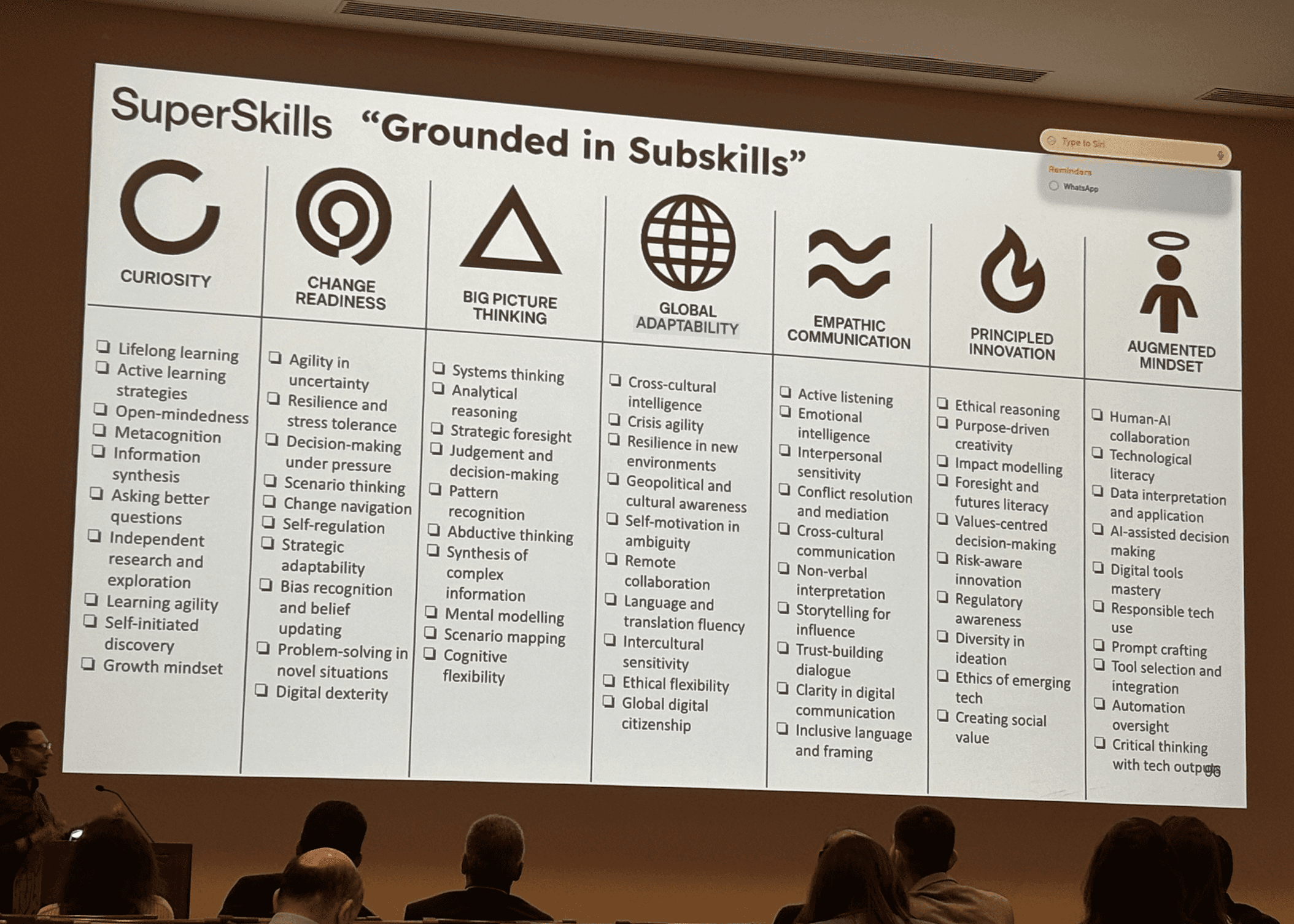
SuperSkill 7: The Augmented Mindset: The Augmented Mindset in the Age of AI
The Augmented Mindset
The question that will define professional life for the next generation is not whether machines will become capable of performing human tasks. They already are. The question is what happens to human capability when the tools become this powerful.
Two trajectories are visible. In one, people use AI as a crutch, offloading cognitive work until their own capacities atrophy. They become dependent on systems they do not understand, unable to function when those systems fail or mislead. In the other, people use AI as an amplifier, extending their reach while strengthening their judgment. They become more capable precisely because they have learned to work with tools that multiply their efforts.
The difference between these trajectories is not intelligence or technical skill. It is a disposition, a set of practices, and a way of thinking about the relationship between human and machine. This is what we mean by the augmented mindset: the cultivated ability to partner with AI and digital tools to extend cognitive, creative, and decision-making capabilities without ceding control or critical oversight.
The stakes are not abstract. They are playing out now in every knowledge profession, every creative field, and every organisation making decisions about how work will be structured. Those who develop this capacity will compound their effectiveness over time. Those who do not will find themselves either displaced or diminished.
The nature of the partnership
The augmented mindset treats AI systems as extensions of one's own cognitive apparatus, analogous to how writing extended memory or how calculation extended numerical reasoning. The philosophical roots trace to theories of the extended mind, which propose that cognition does not stop at the boundaries of the skull. When a tool becomes reliably integrated into thinking, it becomes part of the thinking process itself.
But the analogy has limits. A notebook does not generate novel outputs. A calculator does not offer suggestions. AI systems are active participants in ways that previous tools were not. They produce content, make predictions, and propose solutions. This changes the nature of the relationship from simple tool use to something closer to collaboration, albeit collaboration with an entity that has no understanding, no goals, and no accountability.
The augmented mindset involves recognising both what this collaboration enables and what it requires. It enables processing information at scales impossible for humans alone, generating options and variations at speeds that would otherwise be unattainable, and accessing patterns in data that no human could perceive. It requires maintaining judgment about when to accept machine outputs and when to override them, understanding the limitations and failure modes of the systems in use, and preserving the cognitive capacities that make human contribution valuable.
This is not a passive relationship. The human must remain actively engaged, not merely monitoring but questioning, calibrating, and deciding. The moment the human becomes a rubber stamp for machine outputs, the value of the partnership collapses. Worse, errors propagate unchecked.
What the evidence reveals
Research on human-AI collaboration has accumulated rapidly, and the findings are more nuanced than either enthusiasts or sceptics typically acknowledge.
A systematic meta-analysis of 106 experiments comparing humans alone, AI alone, and human-AI combinations found that on average, human-AI teams performed worse than the best solo agent. In many cases, either the human or the AI acting alone achieved higher accuracy than the combined team. This surprising result highlights how poorly configured collaboration can underperform due to coordination problems or misplaced trust.
But the averages obscure critical variation. Outcomes depended heavily on task type and on who had the initial advantage. In creative and generative tasks, adding AI assistance tended to improve results. In analytic decision tasks, human oversight often failed to correct AI errors, dragging performance down. When humans were naturally better at a task than the AI, combining forces led to improvements that surpassed either alone. When the AI was superior, adding a human tended to reduce performance.
The pattern that emerges is that human-AI collaboration succeeds when humans know when to trust the AI and when to trust themselves. Without that calibration, the partnership fails.
Studies of automation bias document how uncritical acceptance of AI outputs leads to systematic errors. When an AI system suggested incorrect assessments of mammograms, radiologists often deferred to the AI, resulting in marked drops in diagnostic accuracy. In primary care settings, doctors using clinical decision support AI changed their prescribing in roughly one in five cases, and in about one in twenty cases, the AI's bad advice caused them to switch from a correct decision to an incorrect one.
These are not failures of AI. They are failures of the human-AI relationship. The same studies show that when humans maintain active oversight and exercise appropriate scepticism, outcomes improve rather than degrade.
On the positive side, field studies demonstrate substantial gains when the relationship is configured well. A study of 5,000 customer support agents at a Fortune 500 company found that productivity increased 14 percent on average for workers with access to an AI assistant. The gains were concentrated among less experienced staff. Novices with the AI achieved resolution rates equivalent to colleagues with several additional months of training. Crucially, these workers did not become passive recipients of AI suggestions. They followed only about 38 percent of the AI's recommendations, indicating they exercised judgment in applying the tool's advice.
Experiments with generative AI in writing tasks found that college-educated subjects finished roughly 30 percent faster and produced higher-rated outputs than those working alone. Software developers with access to coding assistants completed tasks up to twice as fast. In customer service settings, teams collaborating with AI generated more novel solutions and received fewer hostile responses from customers.
The pattern is consistent: appropriate use of AI tools dramatically improves performance, but only when the human maintains active engagement. The capacity to work effectively with AI is not a bonus. It is becoming a primary determinant of professional effectiveness.
The mechanisms of effective collaboration
The augmented mindset changes outcomes through several reinforcing pathways.
At the cognitive level, effective augmentation involves offloading certain mental operations to AI while focusing one's own attention on higher-level reasoning and judgment. The key distinction from passive reliance is that the human remains engaged in metacognition: monitoring outputs, cross-checking them against context and common sense, deciding whether to accept or override suggestions. This active monitoring creates a feedback loop that sharpens judgment over time.
The AI serves as a kind of cognitive sparring partner. By seeing where the AI is right or wrong, the human receives constant performance feedback. The interplay can improve intuition: patterns become visible, blind spots become apparent, calibration becomes more accurate. Research on novice workers benefiting from AI assistance suggests that the AI effectively transfers best practices, accelerating the development of expertise that would otherwise take months or years to acquire.
At the behavioural level, those with an augmented mindset exhibit distinct habits. They proactively search for tools and information rather than relying solely on familiar manual methods. They invest in learning how to prompt AI systems effectively, recognising that the quality of outputs depends substantially on the quality of inputs. They maintain verification practices, habitually checking critical results rather than assuming correctness.
Another mechanism is cognitive diversity. The AI often brings a different kind of processing, pattern-matching across datasets or generating combinations a human might not consider. The human brings contextual awareness, ethical judgment, and the ability to recognise when something does not fit. When combined properly, this reduces blind spots. But the benefit only materialises if the human remains engaged. Disengagement collapses the partnership into simple automation, eliminating the diversity that makes the combination valuable.
At the organisational level, the augmented mindset creates virtuous cycles. Individuals who develop the capacity become conduits for new tools and practices. Process innovations emerge as workflows are redesigned to maximise human-AI synergy rather than simply automating subtasks. Over time, organisations that embed augmentation practices accumulate experience and data that further improve their capabilities. The advantage tends to widen because both the AI systems and the humans improve with practice.
The developmental challenge
The capacity does not develop automatically through exposure to AI tools. It requires deliberate cultivation.
The central challenge is maintaining cognitive engagement when the tool makes disengagement tempting. AI systems that provide answers reduce the friction of thinking. That reduction is valuable when it accelerates work, but it is dangerous when it bypasses the cognitive processes that build understanding.
Research on cognitive offloading reveals the trade-off. Students who used language model assistants to help write scientific essays experienced lower cognitive load and produced answers faster, but their depth of understanding and retention suffered on follow-up assessments. The AI made the task easier, but the learners did not grapple with the concepts as deeply. Similar patterns appear in programming education: students working with AI tools were more productive initially but reported lower engagement and struggled more when coding without assistance later.
This is not an argument against using the tools. It is an argument for using them differently. The augmented mindset involves recognising when ease comes at a cost and deliberately structuring work to preserve learning. A programmer might review and dissect AI-suggested code to understand it, rather than simply accepting it. A medical student might generate their own differential diagnosis before checking the AI's suggestions, preserving the reasoning process that builds expertise.
The developmental pathway matters. In aviation, extensive cockpit automation has been linked to pilots losing proficiency in cognitive flight skills after months of not practising them. Even highly experienced pilots showed significant deterioration in planning and calculation abilities after just four months of heavy automation use, even though their hands-on control skills remained intact. The parallel in knowledge work is clear: capacities that are not exercised atrophy.
Traditional training approaches struggle with this reality. Classroom instruction can teach the features of tools, but the judgment of when to trust AI outputs, how to verify them, and when to override them develops primarily through practice. The skill is partly metacognitive and partly intuitive, built through repeated cycles of using AI, observing outcomes, and adjusting approach.
Organisations that develop this capacity effectively tend to emphasise experiential learning: sandbox environments where professionals can work with AI on realistic cases, reflect on successes and failures, and develop calibrated intuition. They pair subject-matter experts with those who understand AI capabilities and limitations. They create structures that require human verification of critical decisions while still capturing the efficiency gains of AI assistance.
The failure modes
The capacity fails in predictable ways.
One failure mode is overextension: using AI tools in contexts where they are unreliable, under the assumption that augmentation is always beneficial. An analyst might apply a machine learning model to predict rare, high-stakes events without acknowledging the model's uncertainty or the limitations of historical data. The belief in augmentation becomes technological overconfidence. The result can be worse decisions than a cautious human-only approach.
A second failure mode is automation complacency: initial careful use gradually degrading into passive acceptance as comfort grows and outcomes have been mostly good. The user stops double-checking outputs, stops maintaining their own domain knowledge, and eventually reaches a point where cognitive engagement has effectively ceased. This often happens insidiously, without the person recognising the shift. Studies suggest that both experts and learners may not be aware of the gradual erosion of their own capabilities.
A third failure mode is contextual mismatch: applying AI augmentation in settings where it is inappropriate or unwelcome. Different organisational cultures, professional norms, and regulatory environments have different expectations about AI use. Heavy reliance on AI assistance in contexts where human judgment is explicitly valued, or where AI use raises ethical or legal concerns, can backfire in ways that damage reputation and relationships.
A fourth failure mode is bias amplification: when human and AI share the same blind spots, the combination amplifies rather than corrects errors. If an AI hiring tool exhibits bias against certain groups and the human recruiter assumes the tool is impartial, the augmented decision-making is worse than human judgment alone. The presence of AI output can lend a veneer of authority that makes the human more confident in a flawed outcome.
A fifth failure mode is skill substitution: using AI performance as a proxy for one's own capability. A student who uses AI to produce impressive work may come to believe they have mastered the subject, only to fail when working without assistance. A professional who consistently uses AI analytics may become cavalier and skip human intuition or stakeholder consultation entirely. The misuse is substituting augmented performance for genuine competence.
Each of these failures represents a departure from what the augmented mindset actually requires: active engagement, appropriate calibration, contextual sensitivity, and honest self-assessment.
The organisational imperative
For organisations, the stakes extend beyond individual capability to competitive position.
The evidence increasingly suggests that how well an organisation cultivates augmented thinking among its people will determine how effectively it captures value from AI investments. Technology alone is insufficient. The same tools in the hands of people with different orientations produce radically different outcomes.
Organisations that ignore this dynamic risk several failures. They may invest in AI systems that workers do not use effectively, squandering resources. They may face competitive disadvantage as rivals who develop augmented workforces outpace them in innovation and efficiency. They may encounter compliance and quality problems as workers use AI without guidance, producing outputs that contain errors or violate norms.
In selection and advancement, signals of this capacity are becoming explicit criteria. Hiring managers probe for evidence of technological adaptability and judgment. Promotion decisions increasingly favour those who demonstrate data-informed decision-making combined with sound intuition. Leaders who rely solely on gut feel without leveraging available tools are seen as riskier in an AI-permeated environment.
In leadership development, the profile of effective leaders is shifting. Leaders need to understand AI systems well enough to set appropriate policies, interpret outputs, and make informed decisions about deployment. They need to model the balance between AI leverage and human judgment. Organisations that fail to develop leaders with these capabilities risk misalignment between frontline workers who use AI effectively and senior decision-makers who do not understand what they are doing.
In training and development, traditional approaches struggle because the capacity involves changing behaviour and building intuition, not merely transferring knowledge. Experiential methods, sandbox environments, mentorship by those who have developed effective practices, and integration of AI considerations into existing professional development prove more effective than standalone courses.
The organisations likely to thrive are those that treat augmented capability as a strategic priority, invest in developing it systematically, and create structures that encourage the right kind of human-AI partnership.
The structure of durability
The augmented mindset has properties that allow it to strengthen rather than depreciate over time.
The capacity compounds with practice. Each iteration of human-AI collaboration teaches something about the tool, about one's own decision processes, or about the domain. A professional who adapts to successive generations of AI assistants accumulates layered experience that makes them increasingly adept at integrating new tools. They develop a meta-skill of learning how to learn new systems. Evidence from productivity studies shows that workers who use AI effectively do not plateau; their advantage grows.
The capacity transfers across domains. The core involves adaptability and a method of working with tools, which applies regardless of the specific field. The subskills, including prompt crafting, output evaluation, verification practices, and calibration of trust, are generic and portable. Labour market data shows that people with high digital adaptability successfully shift industries and command wage premiums.
The capacity resists automation because it is fundamentally about what humans uniquely contribute alongside AI. Judgment, contextual reasoning, ethical sensitivity, and creative integration cannot be reliably automated by current or foreseeable systems. You cannot automate the human in the loop because doing so would leave only the AI, and the evidence shows that the combination often outperforms either alone when configured properly. As more tasks become automated, the importance of this capacity for the remaining tasks increases.
The capacity becomes more valuable as technology advances. As AI handles more routine work, the relative value of human judgment and integration increases. The more powerful the tools, the more important it becomes to have people who can steer them, evaluate them, and apply them appropriately. Each leap in AI capability raises the stakes of getting the human-machine relationship right.
The primary threat to durability is not technological but dispositional. The capacity can decay through complacency, through overreliance that atrophies underlying skills, or through failure to keep pace with evolving tools. But this threat is inherent to the challenge the capacity addresses. Maintaining the augmented mindset means maintaining vigilance against exactly these tendencies.
The defining capability
There is a reason this capacity stands as the culmination of the human skills required for an AI-saturated world.
Curiosity drives the exploration of what AI can do. Change readiness allows adaptation to the continuous evolution of tools and contexts. Big picture thinking provides the perspective to see where AI fits within larger systems and longer time horizons. Empathy ensures that the human element remains central in work that affects people. Global adaptability enables navigation of the cultural and contextual variation in how AI is deployed and received. Principled innovation provides the ethical grounding that prevents AI use from causing harm.
But all of these require a final integration: the capacity to actually work with AI in practice, day after day, in the specific tasks and decisions that constitute professional life. The augmented mindset is where the other capacities become operational. It is the capability that translates orientation into action.
The professional who develops this capacity does not merely survive technological change. They become more capable than they could have been in any previous era. They extend their reach, accelerate their learning, multiply their output, and tackle problems that would have been intractable alone. They are not competing with AI. They are compounding with it.
The professional who fails to develop this capacity faces a narrowing path. Tasks that AI can perform without human oversight will be automated. Tasks that AI cannot perform will be performed by humans who can leverage AI effectively. The space between, where AI is used poorly or not at all, is not a sustainable position.
This is not a distant future. It is the present, unfolding unevenly but unmistakably across every field where knowledge work occurs. The question is not whether to develop this capacity but how deliberately to do so, and whether the development will happen by design or be left to chance until it is too late.
The tools are here. The capabilities to use them well are not automatically conferred by their presence. They must be built, practiced, and maintained. Those who do so will shape what comes next. Those who do not will be shaped by it.
Rahim Hirji