
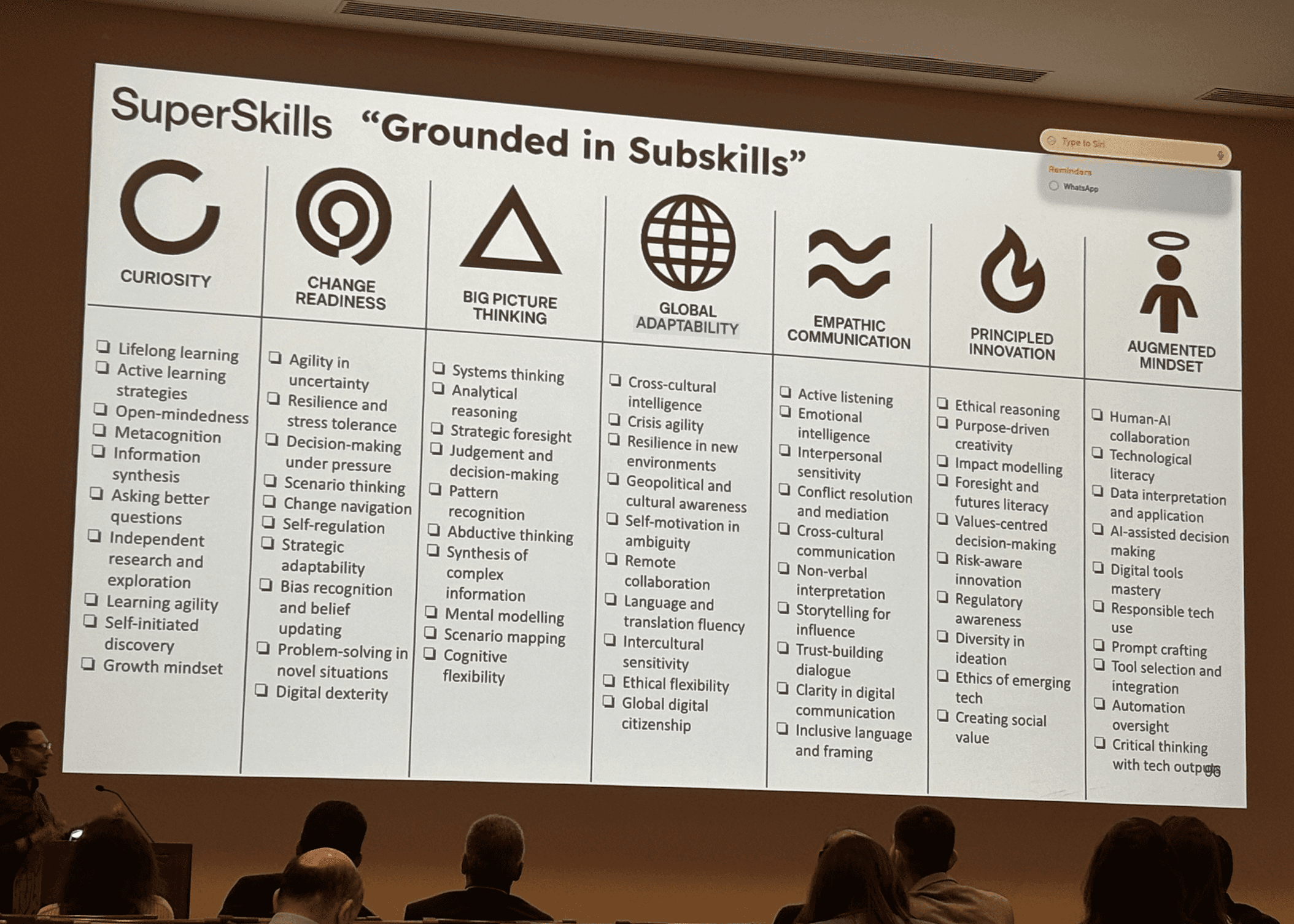
SuperSkill 1: Curiosity: Curiosity in the Age of AI
Curiosity in the Age of AI
Something is changing in how knowledge workers approach problems. In meetings, the reflex to ask clarifying questions has begun to give way to a different reflex: check what the model says. In research teams, the instinct to read primary sources has started competing with the convenience of summarisation tools. In boardrooms, strategic debates that once depended on someone asking "but what if we're wrong?" now defer more readily to dashboards and decision-support systems.
None of this represents failure. These are rational responses to increasingly capable tools. The question is what happens next. Not to the tools, but to the people using them.
The erosion problem
The challenge facing individuals and organisations is not that AI might replace human thinking. The challenge is subtler: AI might gradually reduce the demand for certain kinds of thinking, allowing capacities that depend on regular exercise to weaken through disuse.
Consider what happens when a junior analyst learns to rely on AI-generated summaries rather than reading source documents. The immediate productivity gain is real. But the long-term cost is less visible. Reading primary material builds familiarity with how arguments are constructed, exposes gaps and inconsistencies that summaries obscure, and develops the pattern recognition that underpins expert judgement. Each document read is also a prompt to ask "why is this being framed this way?" or "what would contradict this conclusion?" These are precisely the questions that generate insight.
When the friction of finding information disappears, so does much of the cognitive work that transforms information into understanding. Organisations are beginning to notice this pattern. The problem is not that employees lack access to answers. The problem is that fewer employees are asking the questions that lead to better answers.
What curiosity actually means
Curiosity is the intrinsic drive to seek out knowledge and novel experiences for their own sake. It differs from mere information consumption in one critical respect: it is proactive and internally motivated rather than externally prompted. A curious person does not wait to be assigned a topic before investigating it. They are pulled toward gaps in their understanding because closing those gaps feels rewarding in itself.
This distinguishes curiosity from adjacent concepts that are sometimes conflated with it. Intelligence is the capacity to process and apply knowledge, but curiosity is what generates the desire to acquire knowledge in the first place. Open-mindedness describes a willingness to receive new perspectives, but curiosity describes the active pursuit of them. A growth mindset, the belief that abilities can be developed, may create conditions favourable to curiosity, but does not automatically produce the drive to explore.
Research in psychology identifies curiosity as multidimensional. Some people are drawn to joyous exploration, the delight of discovery for its own sake. Others experience what researchers call deprivation sensitivity, an uncomfortable awareness of knowledge gaps that motivates them to seek resolution. Some are especially curious about other people and their perspectives. Others seek out novelty that involves risk or challenge.
What unites these dimensions is a tolerance for ambiguity. Curious individuals do not require immediate clarity before proceeding. They are willing to sit with uncertainty, to investigate without knowing where investigation will lead. This tolerance is increasingly relevant as environments become more complex and less predictable.
How the evidence developed
The connection between curiosity and outcomes has been studied across multiple domains over several decades. One large synthesis of approximately 50,000 participants found that intellectual curiosity, often measured through assessments of what researchers call a "hungry mind," was a significant independent predictor of academic performance. Notably, curiosity and effort combined explained as much variance in academic outcomes as intelligence.
In organisational settings, the pattern holds. Studies tracking employees in diverse firms found that those who scored higher on curiosity measures received higher performance ratings from supervisors. In one study of e-commerce artisans, a single-point increase on a seven-point curiosity scale was associated with a 34 percent increase in creative output measured by new product designs. Research on call-centre employees found that new hires with higher curiosity were more active in seeking information from colleagues and subsequently handled customer issues more creatively.
The mechanism appears to work through behaviour. Curious people ask more questions, seek more feedback, and experiment more readily. In one intervention study, employees who received daily prompts to ask "why" and explore new topics showed significant increases in innovative behaviours compared to controls. Teams whose curiosity was deliberately heightened through structured exercises outperformed control teams in simulations, attributed to more open communication and more careful listening.
The effects extend beyond professional performance. One longitudinal study of adults aged around 70 found that those who were more curious at baseline were significantly more likely to be alive five years later, even after controlling for medical risk factors. The curious, it seems, do not merely perform better. They may also persist longer.
How AI changes the equation
The relationship between curiosity and AI cuts both ways. On one hand, AI tools can augment human curiosity by providing faster access to information, surfacing connections that might otherwise be missed, and freeing time previously spent on routine tasks. A researcher can now scan vast literatures in hours rather than months. An analyst can explore multiple scenarios that would previously have been prohibitively time-consuming.
On the other hand, the same tools can reduce the incentives to be curious in the first place. When answers arrive instantly, the discomfort of not knowing is relieved before it can motivate inquiry. When AI systems are confident and articulate, there is less social pressure to question their outputs. When summaries are readily available, the cognitive work of reading and synthesising source material becomes optional rather than necessary.
Research on human-AI interaction has begun documenting this dynamic. Studies observe what some researchers describe as a cognitive atrophy paradox: initial use of AI can improve performance and stimulate learning, but extended reliance leads to a weakening of independent reasoning capacities. The pattern is analogous to findings in aviation, where pilots who rely extensively on autopilot systems become less proficient at manual flying.
The mechanism is straightforward. Skills that are not practised atrophy. When AI handles the questioning, investigating, and synthesising, humans lose the opportunity to develop those capacities. The immediate output may be acceptable, but the developmental pathway that would normally build deeper understanding is bypassed.
Studies on students using AI dialogue agents found that heavy users were less likely to critically evaluate answers and more likely to accept outputs without examination. In clinical settings, doctors using AI-assisted diagnostic tools sometimes accepted recommendations at face value, failing to investigate contradictory evidence. These are not examples of AI being wrong. They are examples of humans ceding their role in the inquiry process.
What absence looks like
When curiosity is absent, the consequences manifest differently depending on context. At the individual level, people with low curiosity tend to plateau early in their careers. They develop adequate competence in their initial domain but struggle when circumstances change. They are less likely to seek feedback, less likely to question their assumptions, and less likely to notice when their mental models no longer fit the situation.
At the leadership level, the effects compound. Leaders who lack curiosity tend to generate less trust from their teams and less willingness to share ideas openly. They create environments where questions feel like challenges to authority rather than contributions to understanding. Their organisations become less adaptive because fewer people feel safe raising concerns or proposing alternatives.
At the organisational level, low-curiosity cultures become brittle. They may perform well when conditions are stable, but they lack the capacity to sense weak signals of change or to experiment with new approaches before crises force them to. The failure of once-dominant companies often traces back not to a lack of resources or talent, but to a lack of questioning. Someone in the organisation likely saw the disruption coming. The question is whether anyone asked them about it.
One widely cited survey found that while over 90 percent of employees agreed that curiosity brings new ideas and value, only 24 percent felt curious in their jobs on a regular basis. The gap is not explained by a lack of curious people. It is explained by organisational conditions that suppress curiosity: tight schedules, rigid hierarchies, cultures that punish dissent, and now, increasingly, AI tools that reduce the felt need to question.
Patterns in practice
Across organisations navigating AI adoption, a pattern emerges that distinguishes those who use these tools well from those who use them passively. The distinguishing factor is rarely technical sophistication. It is the stance the organisation takes toward questioning.
In organisations that maintain high curiosity, AI outputs are treated as starting points rather than conclusions. Teams use generated drafts as prompts for further investigation, asking "what did this miss?" and "what assumptions is this making?" Leaders model inquiry by publicly admitting uncertainty and inviting challenge. Experimentation is structured into workflows, with time explicitly allocated for exploring questions that do not have immediate payoffs.
In organisations where curiosity has eroded, AI outputs increasingly substitute for human judgement. Employees copy and submit generated content with minimal review. Questions about accuracy or appropriateness are dismissed as friction. Speed becomes the primary metric, and the distinction between output and insight collapses.
The irony is that organisations pursuing efficiency through AI adoption are often inadvertently creating conditions that undermine long-term capability. They are producing employees who can operate the tools but who cannot evaluate the tools' outputs. When the tools fail, as they inevitably do, there is no residual capacity to detect the failure or to respond creatively.
A different lens for evaluation
The conventional approach to evaluating talent and readiness tends to emphasise what people know and what they have accomplished. These remain relevant, but they are incomplete indicators of long-term capability. What matters increasingly is how people respond to uncertainty, how they approach problems they have not seen before, and whether they continue learning once they have achieved adequate performance.
Curiosity is difficult to assess through credentials or experience alone. It reveals itself in behaviour. Does the person ask clarifying questions before accepting a task? Do they seek out feedback after completing work? Do they read beyond what is required for immediate purposes? Do they notice when their mental models are not working and investigate why?
These are observable patterns, but they require attention to process rather than output. Many organisations remain oriented toward measuring results rather than learning behaviours, which makes it difficult to detect whether curiosity is present or atrophying. The signs are often subtle: a gradual reduction in the questions raised in meetings, a shift in language from "I wonder" to "the model says," a growing reluctance to challenge consensus.
One common misconception is that curiosity is primarily relevant for creative or strategic roles. The evidence suggests otherwise. Curiosity matters wherever conditions change, wherever problems are complex, and wherever routine solutions may not apply. That describes an increasingly large proportion of work.
The compounding nature of inquiry
Unlike skills that peak and decline, curiosity has a structure that allows it to strengthen over time. Each question asked leads to new knowledge, which in turn opens new questions. The more one learns, the more one becomes aware of what remains unknown, which motivates further learning. This creates a virtuous cycle that, if maintained, accelerates rather than plateaus.
The opposite is also true. When curiosity is not exercised, the cycle reverses. Skills built through inquiry begin to erode. The discomfort of not knowing, which normally motivates investigation, becomes something to avoid rather than embrace. AI tools make avoidance easier, and the cycle accelerates in the wrong direction.
What distinguishes those who continue developing from those who stagnate is often not raw ability but sustained attention to the process of inquiry. The capacity to ask good questions, to remain uncomfortable with incomplete understanding, and to investigate rather than assume is not automatic. It requires conditions that support it and habits that maintain it.
Tools will continue to evolve faster than any individual can track. The knowledge that is current today will be outdated tomorrow. In this environment, the capacity that endures is not any particular expertise but the disposition to keep learning. That disposition has a name. It is not new. It is simply becoming more consequential.
Rahim Hirji