
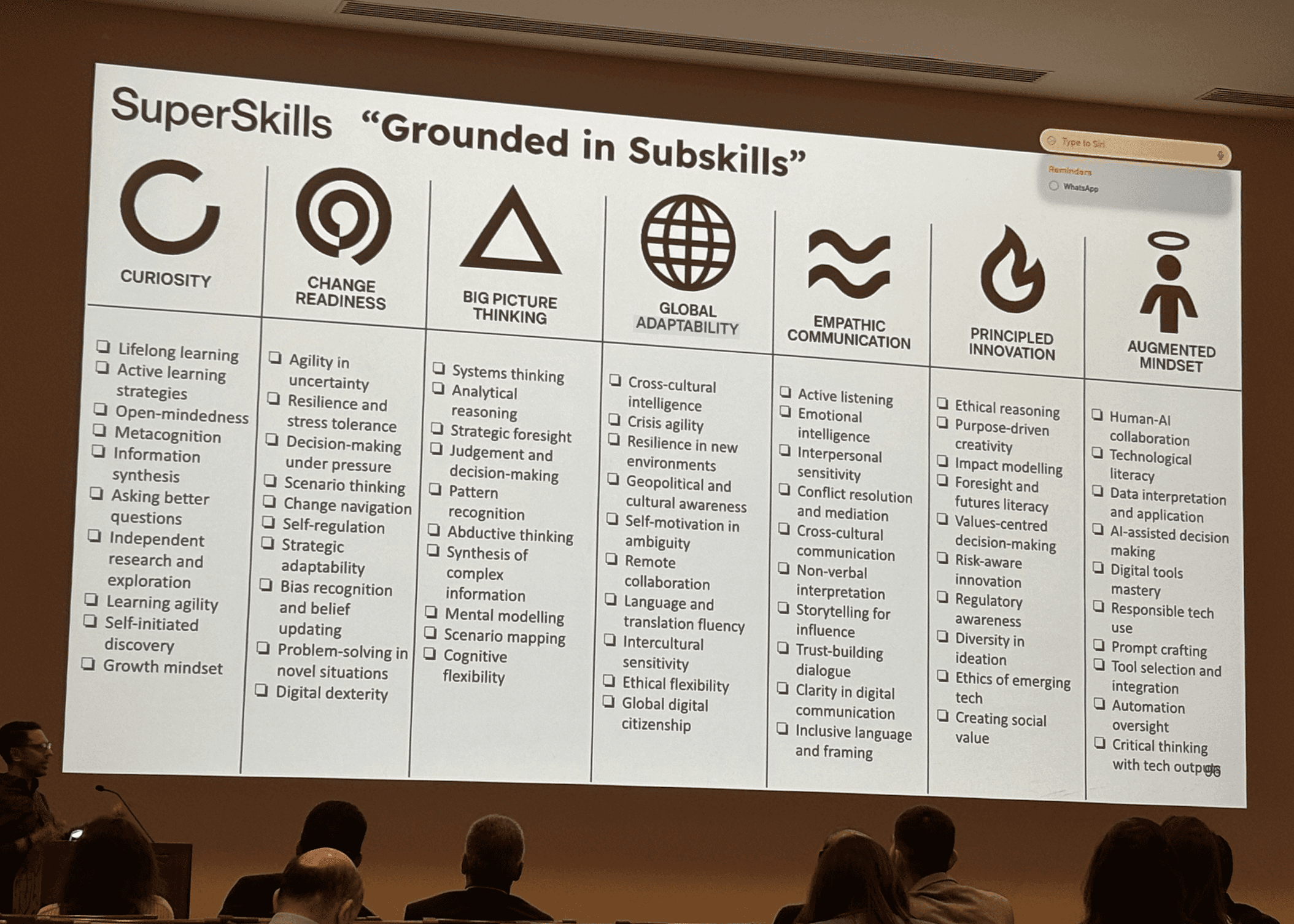
SuperSkill 5: Global Adaptability: Global Adaptability in the Age of AI
Global Adaptability in the Age of AI
When Walmart entered Germany in 1997, its executives saw a straightforward expansion opportunity. They imported the American retail model wholesale: the cheerful greeters, the staff assemblies, the aggressive pricing tactics that had succeeded at home. Within a decade, the company had retreated from Germany entirely, having lost approximately one billion dollars.
The failure was not financial or operational in the conventional sense. It was adaptive. German employees found the forced cheerfulness alienating. Customers were uncomfortable with the American-style friendliness. Labour regulations that differed from US norms created ongoing friction. At every level, the organisation had assumed that what worked in one context would transfer directly to another.
This assumption, and its consequences, illustrates something broader. In a world where organisations operate across borders, where teams span time zones and cultures, and where markets shift faster than formal knowledge can keep pace, the capacity to adjust one's approach without losing effectiveness has become a defining capability.
What the capacity involves
Global adaptability is the ability to function effectively across diverse cultural and situational contexts by adjusting mindset and behaviour while maintaining core integrity. It combines cognitive flexibility, cultural intelligence, and behavioural agility into a meta-competency that enables individuals to navigate environments where the familiar rules do not apply.
The capacity is distinct from related but narrower concepts. It is not equivalent to knowing facts about different cultures. Research consistently shows that motivation and openness to engage across contexts predict success more strongly than accumulated cultural knowledge. Someone who has memorised business etiquette guides for a dozen countries may still fail if they cannot read a room or adjust in real time.
It is not a byproduct of general intelligence or personality. Studies find that cultural intelligence has no significant correlation with cognitive IQ, and while traits like openness facilitate adaptability, the capacity itself involves learnable skills that operate independently of personality factors. People can develop it deliberately rather than simply being born with it.
It is not the same as conforming completely to local norms. Research has documented a dark side to extreme flexibility: individuals adept at blending in can also be more prone to ethical compromise when they adopt uncritical relativism. Genuine adaptability involves calibrating behaviour while retaining a stable sense of values and identity.
And it is not conferred automatically by travel or international exposure. Studies show that international experience alone has only modest impact on measurable adaptability unless accompanied by active reflection and learning. Visiting many countries is not the same as developing the capacity to function well in any of them.
The evidence for its value
Research across psychology, management, and organisational behaviour supports global adaptability as a measurable capability linked to concrete outcomes.
A comprehensive meta-analysis of 70 studies involving approximately 8,000 participants found that higher cultural intelligence was moderately associated with better work outcomes across domains. Employees scoring high on cultural intelligence reported greater job performance and satisfaction in culturally diverse roles. The motivational component, genuine interest and confidence in cross-cultural interaction, was the strongest predictor of performance. These effects held after controlling for general mental ability and personality, indicating that cultural adaptability adds predictive power beyond basic talent measures.
Field studies in organisational settings strengthen the case. A 2023 study of 415 members of international project teams found that individual adaptability and cultural sensitivity had significant positive relationships with team performance. Leaders viewed adaptability as the key driver of high performance in their multicultural teams. A separate analysis of 810 teams in multinational firms confirmed that having multicultural managers corresponded to stronger organisational performance in highly diverse and competitive markets. The effect was most pronounced in environments where diversity was high; in homogeneous contexts, multicultural background made less difference.
Research on creativity provides particularly striking evidence. A series of experiments with MBA students found that those with extended foreign living experience were far more likely to solve classic creativity challenges than those without such experience. Crucially, simply travelling as a tourist had no such effect. It was the adaptive pressure of living in and adjusting to a foreign culture that predicted creative insight. A follow-up study identified the mechanism: students who had actively adapted to the host culture, measured by how much they integrated local norms into daily life, showed significantly higher creativity on subsequent tasks.
The evidence includes important qualifications. Most studies are correlational; causality is inferred rather than proven directly. There is publication bias toward positive findings. And raw international experience can produce overconfidence: people who move between countries without reflective learning may accumulate superficial knowledge but fail to develop genuine adaptability. The skill is real and beneficial, but it is not automatic or magical in its effects.
The pathways through which it operates
Global adaptability produces outcomes through several reinforcing mechanisms.
At the cognitive level, adaptable individuals develop richer mental frameworks for making sense of unfamiliar situations. They consciously monitor and adjust their assumptions when entering new environments, reducing misinterpretation and accelerating learning. Repeated exposure to novel contexts trains the capacity to detect patterns and draw analogies, fostering creativity and decision quality. Each new encounter can broaden perspective, which in turn makes the next encounter easier to navigate. This creates a compounding dynamic: exposure leads to adaptation, adaptation builds new capabilities, new capabilities encourage seeking further exposure.
At the behavioural level, globally adaptable individuals adjust communication and collaboration styles to fit context. They notice and respect subtle differences in norms, preventing minor frictions from escalating. They modulate directness, tone, and body language to match expectations, avoiding offence and building rapport more quickly. Over time, these micro-successes accumulate into trust. Research documents that when team members and leaders are aware of cultural differences and willing to adapt, they establish closer relationships, generate greater trust, and facilitate more creative collaboration.
Adaptable individuals also serve as bridges across divides. In multinational organisations, someone who has lived in multiple contexts can translate between headquarters and local teams, reducing misunderstanding. Studies of diaspora networks show that members with dual cultural identities frequently serve as trust intermediaries in international transactions, because each side perceives them as understanding their perspective. This bridging function accelerates negotiation and innovation by combining knowledge from different worlds.
At the emotional level, adaptable individuals exhibit higher resilience in the face of uncertainty. They reframe challenges as opportunities to learn rather than threats to avoid. Studies show that those high in cultural adaptability experience lower stress and faster adjustment during foreign assignments. They employ active coping strategies rather than avoidance. When mistakes occur, they recover more effectively, maintaining momentum rather than disengaging. This resilience allows accumulation of diverse experiences over time, including occasional failures, without derailing long-term development.
Technology as amplifier and risk
The relationship between AI and global adaptability runs in two directions, creating both opportunity and hazard.
AI can augment certain subskills. Translation tools lower entry barriers for basic communication. Cultural information can be retrieved on demand. AI-driven platforms help coordinate across time zones and can even detect when cross-cultural misunderstandings may be developing. When used appropriately, these tools amplify the impact of human adaptability: a culturally skilled professional with good AI support can connect and learn faster than either could alone.
The limitation is that current AI cannot replicate the full spectrum of adaptive capacity. Machine translation struggles with context, cultural nuance, humour, and idiom. A polite affirmative in one culture may signal reluctance in another; AI cannot reliably detect such signals. AI systems are also only as good as their training data. If that data reflects a narrow cultural lens, outputs may subtly reinforce majority-culture perspectives, giving users a filtered and potentially misleading view of complex contexts.
The more concerning risk is developmental. If AI handles too much of the adaptive work, people may stop building the capacity themselves. Language educators report increasing difficulty motivating students to learn foreign languages when translation apps seem to make fluency unnecessary. But the convenience comes at a cost: struggling through local idiom, observing non-verbal cues, navigating ambiguity without a digital buffer are precisely the experiences that build adaptive capacity. AI, by providing shortcuts, can remove the productive struggle that generates growth.
This dynamic extends beyond language. Remote work mediated entirely through digital platforms can insulate people from the depth of immersion that previous generations experienced through extended foreign assignments. Young professionals may manage international colleagues through screens without ever encountering the disorientation and recovery that forge genuine adaptability. The immediate efficiency gain could produce long-term capability loss at scale.
Where the capacity breaks down
Global adaptability is not without failure modes.
One risk is over-adaptation: becoming so eager to fit in that authenticity erodes and core values become negotiable. Individuals who constantly adjust their persona without an internal anchor can experience stress and confusion. They may also invite mistrust from others who sense the performance. Research documents that highly adaptable individuals are more likely to rationalise ethically questionable behaviour when they embrace extreme relativism. Flexibility without principle becomes something other than adaptability.
A second failure mode is false confidence. Success in one cross-cultural context can produce unwarranted generalisation. A professional fluent in Japanese business culture may assume similar proficiency in Middle Eastern contexts and fail to prepare accordingly. Adaptability is not a bag of transferable tricks. Each context requires fresh observation and calibration. The moment someone believes they have mastered adaptability as a static competency, they have stopped actually adapting.
A third risk is tokenism: cosmetic adaptation without genuine insight. A well-meaning gesture, a few local phrases, an attempt at local dress, can backfire if executed superficially or inaccurately. Recipients may perceive it as pandering or mockery rather than respect. Partial adaptation that maintains deeper assumptions intact can be worse than no adaptation at all.
There are also structural limits. In some environments, no amount of individual flexibility can overcome systemic barriers like discrimination or extreme cultural distance. An outsider may hit ceilings regardless of how well they adapt. In high-stakes situations with little margin for error, standard protocols may be more appropriate than improvisation. Knowing when not to adapt is itself part of mature global competence.
Finally, access is unequal. Opportunities to build global adaptability, through international assignments, study abroad, diverse team leadership, are disproportionately available to those in privileged positions. Organisations that value the capability only when exhibited by certain groups, while overlooking similar skills developed through immigration or domestic diversity, miss talent and perpetuate inequity.
Implications for organisations
The relevance of global adaptability in organisational life has intensified as operations span more borders and technologies connect more contexts.
In selection and advancement, signals of adaptability have become explicit criteria for roles involving leadership, collaboration, or market expansion. These signals include international experience, multilingualism, and track records of leading diverse teams. Some organisations administer behavioural interviews or simulations to assess the capacity more directly. The challenge is that proxies like travel history are imperfect; someone with extensive exposure may have learned little, while someone with less conventional experience may have developed significant adaptive skill.
In leadership development, the difficulty is that adaptability does not transfer well through classroom instruction. Awareness can be raised, but the capacity itself develops through practice in contexts that require it. Effective development approaches include rotation through unfamiliar roles and regions, mentoring that models adaptive behaviour, and action learning projects that embed real stakes. Most learning happens through experience rather than curriculum. Organisations that rely solely on workshops often find limited impact.
In culture and daily operations, leaders with high global adaptability tend to foster inclusive dynamics. They ensure that team members from different contexts are heard. They defuse culture-based misunderstandings. They adjust management practices to fit local realities rather than imposing uniform approaches. During periods of disruption, they are faster to adjust plans and communication, and more attuned to how different groups are affected.
The risk of neglecting the capability is both strategic and operational. Organisations may fail to tap global markets or talent effectively. Products may launch with features that work in one context but fail or offend in others. Teams may fragment along cultural lines. And as AI handles more routine analysis, the human competitive edge concentrates precisely in the areas where adaptability matters most: cultural insight, ethical judgment, and complex human coordination.
The structure of durability
Global adaptability has properties that allow it to strengthen rather than depreciate over time.
The capacity compounds with deliberate practice. Each context navigated adds to a repertoire of approaches. Each adjustment made builds confidence for future adjustments. There is no inherent decay if the skill is continually applied. Older professionals with accumulated international experience often have richer resources to draw upon than they did earlier in their careers. The trajectory is upward for those who remain engaged.
The capacity transfers across domains. The core involves learning and adjusting in novel circumstances, which is fundamentally context-agnostic. Someone who developed adaptability in nonprofit work can apply the same approach in corporate settings. An engineer who learned to bridge differences in international teams can carry that capacity into management. The content of work changes, but the underlying approach to bridging differences and handling ambiguity remains valuable.
The capacity resists automation. No existing AI can replicate the full spectrum of what global adaptability involves: building trust, reading unspoken signals, exercising ethical judgment, responding creatively to situations outside training data. As AI handles more routine functions, what remains for humans is increasingly defined by these adaptive, relational, and contextual capabilities. The relative value of human adaptability rises as technology advances.
The conditions that threaten the capacity are not technological but human: retreat into homogeneity, avoidance of challenging contexts, overreliance on digital shortcuts that remove the productive struggle of direct engagement. These are choices, not inevitabilities.
In a world where change is the constant and diversity is the norm, the capacity to adjust without losing effectiveness is not a specialised skill for a select few. It is a foundational capability for sustained relevance. Those who develop it deliberately will navigate complexity more effectively than those who assume their current approaches will always apply. The only question is whether the development happens by design or is left to chance.
Rahim Hirji