
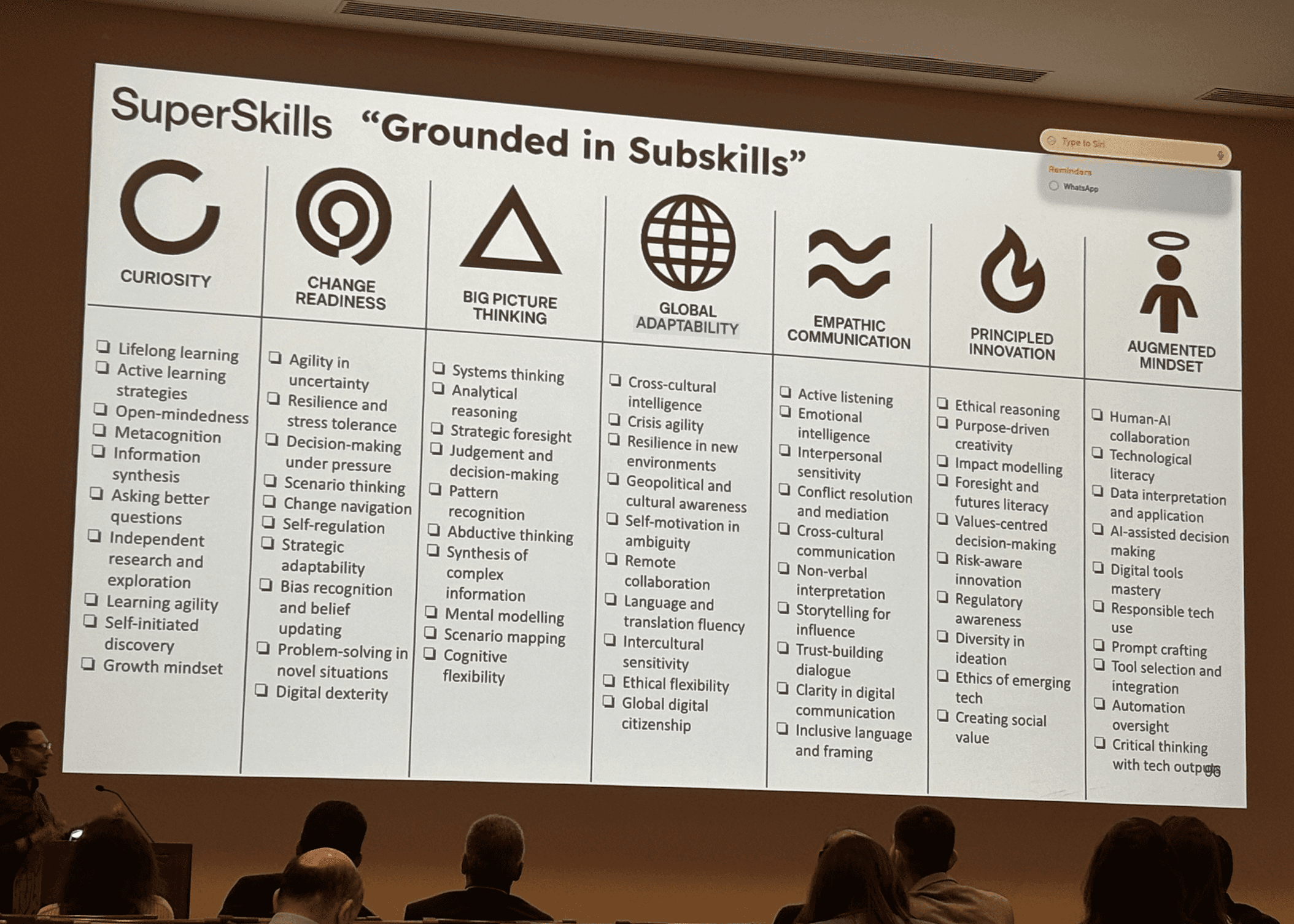
SuperSkill 6: Principled Innovation: Principled Innovation in the Age of AI
Principled Innovation in the Age of AI
In 2015, Volkswagen was caught installing software designed to cheat emissions tests. The vehicles produced up to 40 times the permitted nitrogen oxide levels during normal driving while appearing compliant during laboratory testing. The immediate consequences included a stock price collapse of roughly 20 percent, erasing approximately 28 billion dollars in market value within days. Over the following years, the company incurred more than 31 billion euros in fines, recalls, and legal costs, making it the most expensive corporate scandal in automotive history.
The engineers who designed the defeat device were not incompetent. They solved a difficult technical problem with considerable ingenuity. What they lacked was not capability but constraint. The innovation was unprincipled: it prioritised short-term competitive advantage over the interests of regulators, customers, and the public. The eventual cost exceeded any conceivable benefit.
This pattern recurs across industries and eras. Innovation without ethical grounding produces outcomes that appear successful until they are not. The question is not whether organisations can innovate, but whether they can do so in ways that build rather than destroy long-term value.
The capacity defined
Principled innovation is the practice of generating and implementing new ideas under explicit moral and societal guidelines, ensuring that creativity serves positive ends rather than pursuing novelty for its own sake. It involves imagining and executing solutions guided by principles that create benefit while avoiding harm.
The concept draws from multiple disciplines. In business ethics and innovation management, it aligns with what researchers call responsible innovation: taking care of the future through collective stewardship of science and technology in the present. In moral psychology, it builds on frameworks for ethical decision-making that ensure an innovator's values, empathy, and sense of justice steer the creative process.
Several clarifications distinguish this capacity from adjacent concepts.
It is not innovation at any cost. The "move fast and break things" mindset may produce rapid iteration, but it fails when the things broken include trust, safety, or fairness. Principled innovation asks not only "can we build this?" but "should we build this, and under what conditions?"
It extends beyond compliance or token responsibility. Meeting legal requirements is a floor, not a ceiling. Internalising moral principles into everyday innovation decisions differs fundamentally from treating ethics as an afterthought or public relations exercise.
It differs from traditional innovation focused solely on novelty and market success. Principled innovation adds a filter of stakeholder wellbeing, long-term impact, and justice. It integrates foresight and ethical reasoning so that potential harms are anticipated during development rather than addressed after damage occurs.
It is not personal virtue alone. The capacity requires fusing creative skill with moral and civic judgment, drawing from philosophy, economics, and responsibility to the public good.
The evidence for its effects
Research across organisational behaviour, management, and economics supports principled approaches to innovation as predictive of better long-term outcomes.
A comprehensive meta-analysis of 52 studies involving approximately 33,000 observations found a positive relationship between corporate social responsibility and financial performance. Companies exhibiting what the researchers termed "corporate virtue" tended to perform better financially, particularly on accounting measures. The finding refutes the notion that principled behaviour drags on profits. A separate study of 1,700 companies found that firms with more diverse leadership teams, a proxy for inclusive and values-driven practices, generated 19 percent higher innovation revenues on average.
Trust, a byproduct of principled leadership, translates directly into financial gains. A study of 6,500 employees at 76 hotels found that even small increases in managers' perceived integrity, measured by alignment between words and deeds, raised hotel profits significantly. No other managerial factor had as large an impact on the bottom line.
Longitudinal evidence strengthens the case. An analysis using a 15-year Corporate Horizon Index found that companies classified as long-term focused dramatically outperformed more short-term peers. Over a 14-year period, the long-term firms showed 47 percent higher revenue growth and 36 percent higher earnings growth, with substantially greater investment in research and development. They also recovered faster from economic downturns.
At the individual and team level, research links ethical leadership to increased innovative behaviour. A cross-sectional study across service sectors found significant positive associations between perceived ethical leadership and employees' innovative work behaviour, mediated by a thriving work climate. Employees who saw their leaders as fair, transparent, and principled were more likely to generate and implement new ideas. The mechanism proposed is that ethical leaders create trust and psychological safety, which enhance capacity for creative thinking.
The evidence includes important qualifications. Moral reasoning ability, as measured by standard tests, correlates with ethical decision-making in experimental settings but does not guarantee ethical behaviour in real-world contexts under pressure. Training in codes of conduct yields mixed results. Simply knowing the rules does not ensure following them when situational factors push toward misconduct. This suggests that principled innovation requires more than knowledge; it needs supportive contexts, habits, and intrinsic motivation.
How the mechanisms operate
Principled innovation produces outcomes through psychological, organisational, and economic pathways.
At the individual level, practicing ethical reasoning cultivates a mindset attuned to long-term consequences and fairness. An innovator with this orientation actively considers multiple stakeholders: who might be harmed by a design, how risks can be mitigated, what voices are missing from the conversation. This anticipatory thinking helps identify problems early, when they are still addressable. Research shows that when leaders align their actions with their stated values, employee trust increases substantially, yielding concrete performance gains through extra effort and cooperation.
At the organisational level, principled innovation fosters cultures of trust and psychological safety. When team members trust that colleagues and leaders will behave ethically, they are more willing to share bold ideas and flag concerns. Studies on psychological safety find that teams with high trust report more experimentation and quicker error correction, leading to better innovative outcomes. Principled approaches also reduce internal friction: fewer resources drain into compliance investigations, infighting, or turnover from ethical conflicts, freeing capacity for productive work.
The capacity introduces feedback loops for continuous improvement. Seeking diverse perspectives and criticism means catching design flaws or blind spots early. This inclusive approach not only improves designs but generates stakeholder buy-in; those consulted are more likely to support or adopt the innovation. In economic terms, addressing ethical and social risks upstream prevents explosive downstream costs such as lawsuits, boycotts, and recalls that can derail an innovation entirely.
Over time, consistent principled behaviour accumulates reputation capital. This creates structural advantages: lower cost of capital because investors view principled companies as less risky, easier recruiting because talented people prefer mission-driven organisations, and stronger brand loyalty because customers stick with companies they trust. These advantages compound, enhancing capacity to innovate effectively in subsequent generations.
The impact often shows up over longer time scales through feedback loops. Launching a product after thorough ethical review may be slower initially, but it averts potential disasters that would have destroyed years of investment. A principled pause leads to sustainable innovation; an unprincipled rush often leads to wasted effort or worse.
The AI relationship
Artificial intelligence creates distinctive dynamics for principled innovation, offering both amplification and risk.
AI can enhance certain aspects of the capacity. Systems that process vast data can simulate the impacts of an innovation, modelling environmental or social effects far faster than humans working alone. AI-driven tools for sustainability can analyse a product's carbon footprint across its lifecycle, flagging ethical issues early. Scenario analysis powered by machine learning can predict how different populations might be affected by a policy innovation, informing more ethical design. Natural language processing can scan documents for biased language or regulatory violations, serving as an ethics checklist to augment human oversight.
By handling routine analysis, AI can free human innovators to focus on what machines cannot do: value judgments, empathy, and context-specific ethical reasoning.
The limitation is that AI lacks genuine understanding of moral values and cannot fully grasp context or foresee all social ramifications. Algorithmic decisions often carry a veneer of objectivity while embedding human biases and missing deeper questions of justice. Grappling with moral trade-offs and value conflicts cannot be offloaded entirely to AI because these are not purely technical problems.
Empirical examples reinforce this. Amazon's AI hiring tool taught itself to downgrade female candidates based on patterns in historical data. The system was scrapped because AI could not be reliably fixed to judge candidates fairly. Criminal justice algorithms have perpetuated racial biases present in training data while appearing neutral. These cases illustrate that ethical reasoning and contextual understanding remain weak spots for AI. Human judgment must remain in the loop.
A documented risk is automation bias, where people become too deferential to algorithmic outputs and stop exercising their own critical judgment. Studies in aviation and medicine have observed that as operators relied on automated systems, they sometimes missed obvious errors or failed to intervene appropriately. Translated to innovation contexts, if teams lean excessively on AI-driven analytics, they might neglect common-sense ethical questions the AI did not flag.
There is also a developmental concern. Professionals traditionally develop ethical judgment through experience, learning from the consequences of decisions and internalising the importance of various considerations. If AI systems take over more decisions, humans may have fewer opportunities to encounter situations that build moral reasoning capacity. The very experiences that develop principled innovation may be bypassed.
The appropriate relationship positions AI as a tool that augments human judgment rather than substitutes for it. AI handles information processing and pattern detection; humans provide moral reasoning, accountability, and the integration of values into decision-making.
Where the capacity fails
Principled innovation can fail or backfire when misapplied or co-opted.
One failure mode is paralysis. If individuals or organisations become so concerned with avoiding any risk or offending any value that they enter endless deliberation, innovation can stall entirely. Overzealous ethical review loops or requirements for universal consensus can make projects infeasible. The intent is principled, but the approach produces stagnation. Finding proportionality matters; principles should guide innovation, not immobilise it.
A second failure mode is ethics washing: adopting the language of values and purpose for image purposes without following through in practice. Grand statements about social impact that coexist with decisions driven by short-term profit foster cynicism and eventual scandal. When the gap between rhetoric and reality becomes visible, trust damage is often worse than if no ethical claims had been made. Employees and stakeholders recognise hypocrisy, and the discovery of it accelerates rather than prevents reputational harm.
A third failure mode is moral licensing. Psychological research shows that people who consider themselves highly moral can sometimes be more prone to ethical missteps later, feeling they have earned slack or moral credit. A team that completes an ethics training or publishes a noble mission statement may let their guard down subsequently, assuming their good intentions guarantee good outcomes. Past virtue does not ensure future virtue. Overconfidence in one's moral compass can become a blind spot.
A fourth failure mode is groupthink. A tight-knit team that shares strong values might become insular and resistant to outside critique, inadvertently undermining the diversity and reflexivity that principled innovation requires. Confirmation bias can lead an innovator to interpret data as supporting their ethical solution while overlooking signs of harm. Values-centred decision-making, if not paired with empirical feedback, can become dogmatic.
A fifth failure mode involves trade-offs poorly managed. Principled innovation sometimes requires choosing between competing values, and getting these wrong causes failure. Speed and thoroughness, safety and access, privacy and transparency may conflict. Delaying too long can mean missing opportunities to help people; moving too fast can mean causing avoidable harm. Both errors occur. Anticipating secondary and tertiary effects, especially where one value undermines another, is difficult to do perfectly.
The common thread in these failures is a lapse in genuine principled practice: lacking follow-through, perspective, or balance. They are reminders that the capacity is hard and requires continuous self-awareness, dialogue, and adjustment.
Implications for organisations
Principled innovation has moved from a soft ideal to a hard strategic factor, particularly as AI capabilities expand and societal scrutiny intensifies.
In selection and advancement, organisations increasingly seek leaders who combine innovation capacity with a strong ethical compass. Behavioural interview questions about past ethical dilemmas, assessments of social awareness and systems thinking, and track records of purpose-driven projects have become common signals. High-potential employees are evaluated on value-based leadership in addition to innovation output.
In culture and leadership, those who embody principled innovation set the tone for the organisation. Studies show ethical leadership cascades: when top management emphasises values and long-term purpose, middle managers and teams feel empowered to act accordingly. This reduces integrity risks that can derail innovation. It also supports employee engagement, particularly among younger workers who report higher satisfaction when they feel their work has purpose and their employer behaves ethically.
In development, the challenge is that principled innovation is difficult to build through traditional training alone. One-off ethics seminars have limited impact unless paired with real-world practice and cultural reinforcement. Simulation exercises, stretch assignments involving ethics review, and integration of ethical considerations into stage-gate processes prove more effective than lectures. The real test occurs when employees face live trade-offs; how leadership coaches and rewards decisions in those moments teaches more than any classroom.
The risk of neglecting the capacity is both strategic and operational. Regulators and the public are less forgiving of innovations that cross ethical lines. Scandals spread rapidly and invite scrutiny that constrains future activity. Organisations without principled innovators may develop powerful tools but face boycotts, bans, or the loss of talent who prefer to work elsewhere. Those that embed the capacity into hiring, processes, and incentives position themselves to avoid disasters and capitalise on the trust economy.
The structure of durability
Principled innovation has properties that allow it to compound rather than depreciate.
Trust and reputation, once earned through principled action, accrue over time. Individuals and organisations that demonstrate integrity gain latitude and social capital for future endeavours. Stakeholders give the benefit of the doubt. This is self-reinforcing: the person or organisation is given more autonomy and resources because they have proven they will not misuse them, which further enhances capacity to innovate effectively.
The skill itself improves with practice. Someone who regularly navigates ethical decisions in innovation becomes faster and more adept. There is no evidence of an expiration date; the core elements, ethical reasoning, foresight, and creativity, are evergreen human capacities that deepen through reflection and experience.
The capacity transfers across domains. The fundamental ability to balance creativity with ethics applies regardless of sector. Ethical reasoning, stakeholder empathy, and risk awareness are domain-agnostic. As technology changes, the specific issues change, but the underlying skill of how to approach them is portable.
The capacity resists automation. Ethical judgment, value-based decision-making, empathy, and creative foresight are not reliably automated by current or foreseeable AI. No AI can shoulder moral responsibility or reliably navigate value conflicts. Until machines achieve moral agency, humans remain irreplaceable for this work.
The capacity becomes more valuable as technological power increases. The greater the potential for impact from new tools, the higher the stakes of getting it wrong. AI, gene editing, and pervasive data collection have made ethical governance a top concern. People who can steer high-powered innovation responsibly are in growing demand. The value of principled innovation scales with the power of innovation itself.
The conditions that threaten the capacity are human, not technological: short-term pressure, cultures that reward speed over soundness, leaders who treat ethics as an obstacle rather than an asset. These are choices, not inevitabilities. Where they are resisted, principled innovation strengthens with use and time.
In a world where the consequences of innovation propagate faster and farther than ever, the capacity to direct creativity toward genuine benefit while avoiding preventable harm is not a constraint on progress. It is what makes progress sustainable. Those who develop it will build things that last. Those who neglect it will discover, eventually, that what they built was borrowed against a future that will demand repayment.
Rahim Hirji