
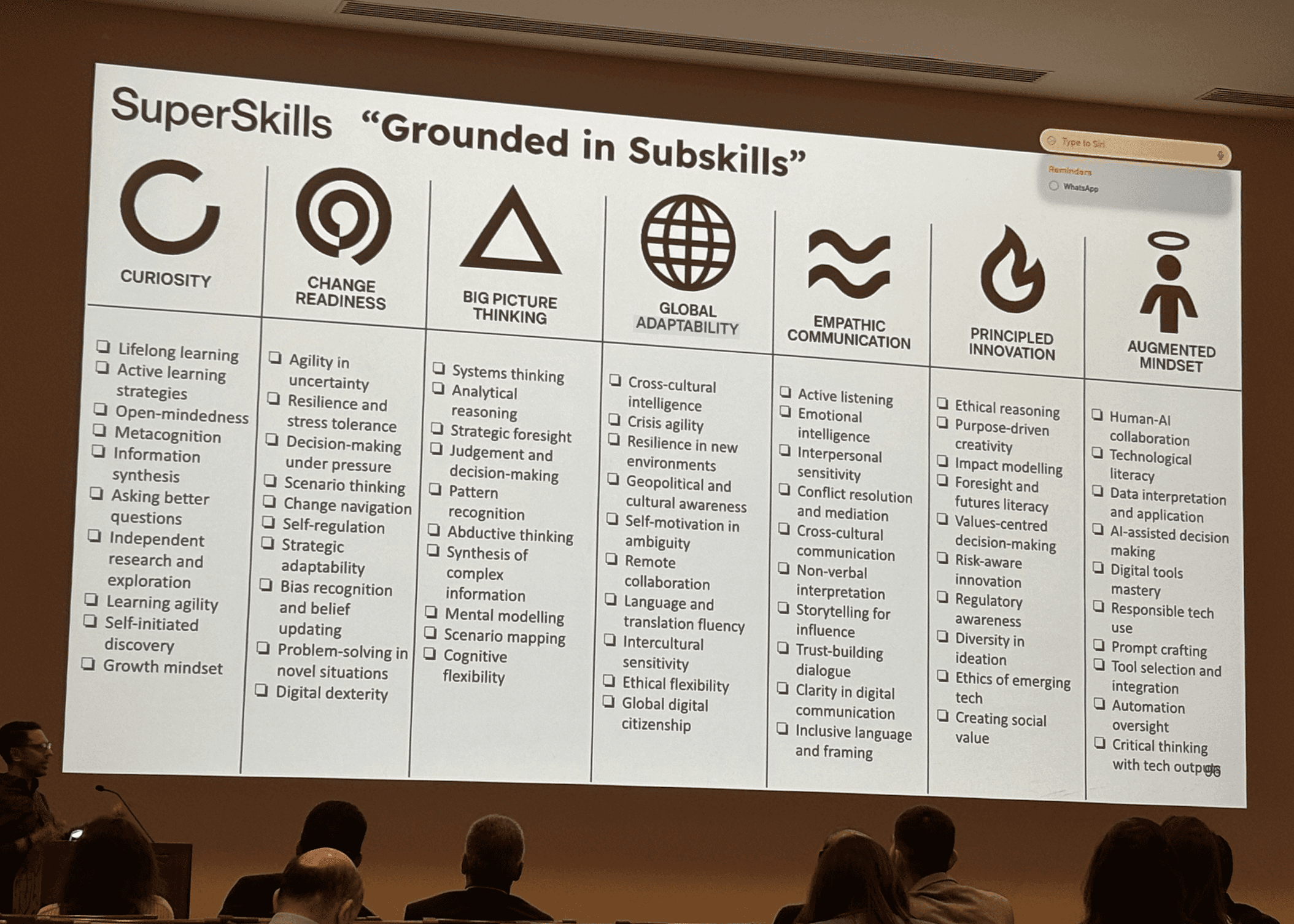
SuperSkill 2: Change Readiness: Change Readiness in the Age of AI
Change Readiness in the Age of AI
The pace at which organisational conditions shift has accelerated beyond what most planning cycles can accommodate. Strategic plans drafted in January require revision by March. Technology stacks adopted last year are superseded by new architectures this year. Roles that were central to operations a decade ago no longer exist, while roles that did not exist then now define competitive advantage.
This is not news to anyone who has led a team or run a business in recent years. What is less often discussed is what this means for the people inside these organisations. Not their job titles or reporting structures, but their capacity to function well when the ground beneath them moves.
The nature of the problem
The conventional approach to managing change treats it as a discrete event. A new system is implemented. A restructuring is announced. A crisis emerges. In each case, the organisation mobilises resources, communicates expectations, and manages the transition until a new steady state is achieved.
This model assumes that periods of change are interruptions to normal operations. The goal is to move through them as quickly as possible and return to stability. But the assumption of returning to stability has become increasingly difficult to defend. For many organisations, the transitions have begun to overlap. The new steady state arrives already outdated.
The implication is that the capacity to navigate change is no longer a crisis management skill. It is a baseline requirement for sustained performance. Yet most individuals receive little preparation for this reality. Educational systems train people to master defined bodies of knowledge. Professional development focuses on acquiring specific competencies. Neither systematically develops the capacity to function when conditions are unfamiliar, uncertain, or actively shifting.
The result is a growing mismatch between what environments demand and what individuals are equipped to provide. Studies tracking employee experience during periods of organisational change consistently find that a significant proportion struggle to adjust. The struggle is not primarily about skill deficits in the technical sense. It is about the capacity to recognise that circumstances have changed, to update assumptions accordingly, and to generate new approaches under pressure.
What change readiness means
Change readiness is the capacity to adapt one's thinking and behaviour in response to novel, uncertain, or volatile conditions. In cognitive science, this maps onto what researchers call cognitive flexibility: the ability to shift mental strategies when circumstances demand it. In organisational psychology, it corresponds to adaptive performance, the demonstrated ability to modify behaviour to meet the needs of new situations.
The definition matters because change readiness is frequently confused with adjacent concepts. It is not the same as resilience, which describes the ability to recover from setbacks. Resilient individuals endure hardship and bounce back. Change-ready individuals recognise shifts and adjust before bouncing becomes necessary. The distinction is between absorbing impact and anticipating it.
Change readiness is also distinct from optimism or positive attitudes toward change. Having a favourable disposition toward new initiatives does not guarantee the ability to execute adaptive behaviour under pressure. Research examining the relationship between personality traits and adaptive job performance found that openness to experience, which intuitively seems related, was not a significant predictor when other factors were controlled. What predicted adaptive performance were traits like proactive drive and emotional stability: the motivation to act and the composure to do so under stress.
The capability is multidimensional. It includes a cognitive component: the ability to update mental models and switch strategies. It includes an emotional component: the regulation of stress responses that would otherwise narrow attention and trigger defensive routines. And it includes a behavioural component: the willingness to seek feedback, experiment with alternatives, and learn from the results.
The evidence base
The empirical foundation for change readiness has developed across multiple disciplines over the past two decades. A meta-analysis examining 71 independent samples confirmed that adaptive performance is a measurable aspect of work behaviour, distinct from routine task performance. The analysis demonstrated that adaptability can be predicted by specific individual differences and that it operates consistently across varied contexts.
Field studies have established links between adaptability and concrete outcomes. Research introducing individual adaptivity as a dimension of work performance found that employees who adjusted their approaches in uncertain, changing environments received higher performance ratings than those who did not, even when controlling for proficiency in core tasks. A critical incident analysis of over 1,000 incidents across 21 jobs identified eight dimensions of adaptive behaviour that were observed across occupations and valued by employers.
Longitudinal evidence suggests that adaptability benefits accumulate. Studies tracking professionals over extended periods found that those who scored higher on adaptability measures early in their careers experienced more frequent advancement and less derailment during economic disruptions. During the pandemic, individuals with higher self-rated adaptability maintained significantly higher job engagement and wellbeing throughout the period of disruption.
The pattern extends to team and organisational levels. A well-known study of 51 work teams demonstrated that psychological safety, the shared belief that one can take risks without punishment, predicted team learning behaviour, which in turn predicted performance outcomes. Teams that felt safe to discuss errors and experiment with new approaches outperformed those that did not. This finding has been replicated across industries and suggests that adaptability is not merely an individual trait but a collective capacity that environments can cultivate or suppress.
A recent large-scale survey of 30,000 workers found that individuals who rated themselves high in adaptability were nearly four times more likely to be in the top quartile of work engagement and nearly four times more likely to report frequently making innovative suggestions, compared to those who rated themselves low. While self-report measures carry limitations, the size of these differences, controlled for industry and demographics, points to a meaningful relationship.
How the mechanisms work
The research identifies several pathways through which change readiness produces outcomes.
At the cognitive level, adaptable individuals are faster to detect that circumstances have changed and quicker to inhibit outdated response patterns. Laboratory studies of cognitive flexibility show that people high in this capacity waste less time persisting with ineffective approaches and begin generating alternatives sooner. This creates a compounding advantage: each novel problem solved adds to a repertoire of strategies available for future situations.
The behavioural pathway operates through proactive learning. Change-ready individuals tend to scan for early signals of change and experiment with adjustments before situations become critical. Studies show they engage more frequently in feedback-seeking and on-the-job skill acquisition. These behaviours form a reinforcing cycle. Experimentation yields results from which the individual learns, building confidence and capability for subsequent challenges.
The stress regulation pathway prevents the cognitive breakdowns that impair performance under pressure. Research on adaptive leaders in crisis simulations found that those rated highest in adaptability maintained lower physiological stress markers and articulated more contingent plans. By keeping arousal at moderate levels, they preserved cognitive resources for creative problem-solving while others experienced tunnel vision.
At the organisational level, the presence of change-ready individuals creates cascading effects. Leaders who model flexibility and experimentation encourage similar behaviours in their teams. When many individuals possess the capacity, the organisation develops collective adaptive capability: the ability to sense, interpret, and respond to environmental shifts faster than competitors.
The AI dynamic
The relationship between AI and change readiness cuts in two directions.
AI can support change-ready individuals by handling information overload and generating options, reducing cognitive load during complex situations. Research in military contexts found that decision-makers with AI-assisted tools responded faster to changing conditions when they used the tools appropriately. The key phrase is "used appropriately." The human still made the adaptive judgment; the AI accelerated access to information.
A recent study comparing human and AI performance in video games requiring flexible self-orientation found that humans vastly outperformed even state-of-the-art AI algorithms when game conditions were unpredictably altered. The AI could master fixed rule sets at superhuman levels, but when conditions changed, it failed to recognise the need to adjust. Human players detected the shift and adapted within a few trials. The researchers noted that human adaptability involves an implicit sense of self and context that current AI lacks.
This suggests that as AI handles more routine pattern recognition and optimisation, the human contribution shifts toward precisely the kind of flexible, cross-context judgment that change readiness provides. The more capable the tools, the more valuable the capacity to know when their outputs no longer apply.
The risk lies in the opposite direction. When AI systems perform challenging parts of tasks, people stop practising those mental skills. Research on automation in aviation has documented that pilots who seldom fly manually lose proficiency in emergency handling. They become less adept at exactly the adaptive manoeuvres needed when automation fails.
The pattern generalises. Heavy reliance on GPS navigation correlates with poorer spatial memory and navigation ability. Studies in healthcare simulation found that trainees using AI diagnostic aids were subsequently less able to make correct decisions on novel cases, apparently because they skipped the deep reasoning that would have built transferable expertise.
The mechanism is straightforward. Skills not practised atrophy. When AI handles the adjustment, humans lose the opportunity to develop their own capacity for adjustment. The immediate performance may be acceptable, but the developmental pathway that normally builds adaptability is bypassed.
A particularly concerning aspect is that individuals may not notice their own decline. They perform well as long as the AI functions correctly, which creates a false sense of competence. When conditions shift beyond the AI's training, they struggle in ways they would not have had they maintained the underlying skill.
What absence looks like
When change readiness is absent, the consequences manifest at multiple levels.
Individuals low in adaptability tend to plateau early. They develop adequate competence in initial conditions but struggle when circumstances change. They are less likely to seek feedback, less likely to question assumptions, and more likely to persist with approaches that are no longer effective. Under pressure, they exhibit what researchers call threat rigidity: narrowing attention and falling back on familiar routines even as those routines produce diminishing returns.
At the leadership level, low adaptability creates environments where questions are treated as challenges to authority rather than contributions to understanding. Teams in such environments become less willing to surface concerns or propose alternatives. The organisation loses access to the early warning signals that might have enabled proactive adjustment.
Organisationally, the absence of change readiness produces brittleness. Performance may be acceptable when conditions are stable, but the capacity to sense and respond to shifts is missing. When disruption arrives, there is no adaptive reserve to draw upon. Research on healthcare units found that those subjected to continuous procedural changes without adequate recovery periods showed declining adaptability over time, not increasing mastery. Staff became apathetic and emotionally exhausted. This pattern, called change fatigue, represents the exhaustion of adaptive capacity, making successful future changes less likely precisely when they become more necessary.
The failure of once-dominant companies often traces to this dynamic. Post-mortems of organisations that missed major technological shifts frequently identify cultures that rewarded operational excellence over experimentation. They selected against adaptability until the environment made adaptability essential, by which point the capacity had atrophied.
Patterns in practice
A pattern distinguishes organisations that maintain adaptive capacity from those that lose it.
In adaptive organisations, challenge is structured into development. High-potential employees are rotated through unfamiliar roles and regions. Stretch assignments are treated as investments in capability rather than risks to be avoided. Failure in experimentation is treated as data rather than grounds for punishment. Leaders explicitly model the admission of uncertainty and the invitation of challenge.
One global consumer goods company added learning agility as a core factor for identifying high-potential managers after internal analysis showed that managers who had rotated through different markets were more successful in senior roles. Another technology company restructured its performance criteria to include how well employees adapt and collaborate, not just what they deliver against static targets.
The common element is that these organisations treat adaptability as a capability that requires exercise. They create conditions that demand adjustment before crises force it. They recognise that comfort zones, while efficient in the short term, produce rigidity in the long term.
Organisations that neglect this pattern often do not notice the erosion until it becomes acute. They may interpret early success in stable conditions as evidence of capability rather than as a function of favourable circumstances. When conditions change, they discover that the people who performed well in stability cannot perform comparably under pressure.
A different frame for evaluation
The conventional approach to evaluating talent emphasises knowledge and accomplishment. What someone knows and what they have achieved. These remain relevant but incomplete indicators of long-term capability.
What matters increasingly is how individuals respond to the unfamiliar. Do they notice when conditions have changed? Do they update their assumptions or defend their existing views? Do they seek information that might contradict their current approach? Do they experiment with alternatives or wait to be told what to do?
These questions are more difficult to answer from credentials alone. They require observation over time and, ideally, exposure to conditions that actually test adaptability. Many organisations lack systematic methods for this kind of assessment, which means they often discover capability gaps only after circumstances reveal them.
One common misconception is that adaptability is primarily relevant for senior or strategic roles. The evidence suggests otherwise. Adaptive performance matters at every level where conditions are uncertain or variable. That describes an expanding proportion of work as automation handles the predictable and leaves humans responsible for the rest.
Another misconception is that adaptability is a fixed trait: some people have it, others do not. Research on career adaptability and learning agility consistently shows that while individuals differ in starting points, the capacity can be developed through experience and practice. The critical variable is whether the environment provides opportunities to exercise and refine the skill.
The compounding structure
Unlike technical skills that may become obsolete, change readiness has a structure that allows it to compound. Each adaptation successfully navigated adds to a repertoire of strategies. Each novel problem solved builds confidence for subsequent challenges. The more varied the situations encountered, the broader the base from which to draw analogies and approaches.
This compounding depends on continued exercise. The capacity weakens without use. Individuals who remain in narrow comfort zones for extended periods lose the edge that variation maintains. Organisations that automate challenge out of roles may inadvertently automate adaptability out of their workforce.
The implication is that change readiness is not something to be developed once and assumed thereafter. It is a capability that requires ongoing investment. The returns on that investment, however, are durable in a way that specific technical knowledge is not. Technologies change. Markets shift. The capacity to navigate whatever comes next remains relevant regardless of what form the next disruption takes.
Environments will continue to demand adjustment. Tools will continue to evolve faster than any individual can master in advance. The capacity that persists through these shifts is not any particular expertise but the disposition and ability to acquire new expertise when circumstances require it. That capacity does not guarantee success, but its absence increasingly predicts difficulty. The choice is not whether to develop it but whether to do so deliberately or leave it to chance.
Rahim Hirji