
The Human-Centred AI Glossary
The AI Dictionary that you didn't realise you needed
Most AI glossaries explain how machines work. This one explains what humans need to know. Every term here is defined through a single lens: does this help you stay the author of your own decisions?
A
Absent User
The person affected by a decision but not present when it is made. Naming the absent user keeps systems humane and prevents harm by default.
Adaptive Intelligence
The combined strength of human judgement and machine speed working together, with humans retaining responsibility.
Agency
The capacity to shape circumstances rather than be shaped by systems, habits, or automation.
Agentic AI
AI systems that take autonomous action toward goals with limited supervision. As agency increases, human guardrails become essential.
Algorithm
A set of instructions that turns inputs into outputs. In modern systems, algorithms increasingly influence decisions once made by people.
Algorithmic Drift
The gradual transfer of judgement from humans to automated systems through defaults and convenience.
Alignment (AI Alignment / Value Alignment)
Ensuring AI systems pursue outcomes humans actually want, rather than optimising narrowly in harmful ways.
Anthropomorphism
Treating AI systems as if they think or intend, leading to misplaced trust.
Artificial General Intelligence (AGI)
A hypothetical form of AI capable of learning and reasoning across domains at or beyond human level.
Artificial Intelligence (AI)
Systems that learn patterns from data to predict, classify, or generate outputs. Powerful tools, not moral agents.
Attention (Self-Attention)
The mechanism that allows AI to weight which inputs matter most. Humans do this naturally; machines must be trained.
Attention Economy
The competition to capture and monetise human focus, often at the expense of depth or wellbeing.
Augmented Mindset
The disposition to treat AI as an extension of capability, not a replacement for judgement.
Authorship
Taking visible responsibility for decisions and meaning rather than deferring to systems.
Automation
Delegating tasks to systems that operate without continuous human input. Valuable only with accountability.
B
Bearings
Your moral and cognitive orientation when speed increases and systems accelerate.
Benchmark
A test used to compare system performance. What gets measured gets optimised.
Bias (Algorithmic Bias)
Systematic distortion caused by skewed data or assumptions.
Black Box
A system whose internal reasoning cannot be easily inspected or explained.
Boundary Erosion
The quiet expansion of what systems decide without explicit permission.
C
Cadence
A steady rhythm of work and reflection that replaces urgency with progress.
Capability Decay
The slow loss of relevance when skills are not practised or updated.
Chain-of-Thought
Prompting AI to show intermediate reasoning steps. Helpful for inspection, not proof of understanding.
Change Readiness
The ability to move without panic when conditions shift.
Cognitive Exoskeleton
Tools that extend human thinking without replacing judgement.
Cognitive Offloading
Delegating mental effort to tools. Useful when deliberate, risky when unconscious.
Compute
The processing power required to train and run AI. Access shapes who can build and scale.
Confabulation (Hallucination)
When AI generates confident but false outputs because it predicts plausibility, not truth.
Context Window
The amount of information an AI system can consider at once.
Curiosity Dividend
The compounding return from asking better questions over time.
Curiosity Loop
See → Seek → Shift. A repeatable learning cycle.
D
Dark Pattern
Design that nudges people into choices they would not make with full clarity.
Data Gravity
The tendency for power, talent, and decisions to cluster around data holders.
Decision Debt
Choices made without reflection that later require costly correction.
Deep Learning
Layered pattern-learning systems. Powerful at recognition, weak at meaning.
Defaults
Pre-set choices that run unless humans intervene.
Deskilling
Loss of human capability when practice is replaced by automation.
Design
Conscious authorship. Choosing direction instead of accepting drift.
Design Debt
The cost accumulated when speed overrides care.
Digital Drift
The quiet surrender of time and attention to algorithmic curation.
Diffusion Model
AI that generates images by refining noise into form.
Drift
Unconscious compliance with systems or habits that decide for you.
Drift Debt
The accumulated cost of uncorrected small shortcuts.
Drift vs Design Matrix
A lens for diagnosing whether action is deliberate or default.
E
Edge (Edge Computing)
Processing done locally rather than remotely. Keeps data closer to people.
Embedding
A numerical representation of meaning. Proximity is not understanding.
Emergent Behaviour
Capabilities that appear at scale without being explicitly designed.
Empathy
Understanding others well enough to act with their reality in mind.
Empathy Gap
The distance between what systems optimise and what humans feel.
Epistemic Humility
Knowing the limits of what you or any system can know.
Ethical Pre-Mortem
Imagining how harm could occur, then preventing it.
Explainable AI (XAI)
Making AI decisions understandable to humans.
Exponential Change
Acceleration that feels slow until it overwhelms existing systems.
F
February 29 Cycle
Spot, Sense, Shift, Shape. An adaptability loop for disruption.
Feedback Loop
When outputs become inputs. Loops can amplify wisdom or error.
Fine-Tuning
Adapting a general model to a specific context. Values are encoded here.
Five Loops
A weekly rhythm sustaining agency through learning and leverage.
Fragility Index
How dependent a system is on one person or assumption.
Friction (Productive Friction)
Deliberate slowness that prevents harm or preserves dignity.
Frontier Model
The most capable AI systems available at a given moment.
G
Generative AI
AI systems that create new content from learned patterns.
Global Adaptability
Thriving across cultures and constraints.
Global Mirror
A trusted local check on intent and impact.
Grounding
Connecting outputs to verifiable sources.
Guardrails
Non-negotiable limits protecting safety and accountability.
H
Half-Life of Skills
The time it takes for half of what you know to become outdated.
Hand–Head–Hours
What stayed human, what was learned, and where time went.
Hidden Labour
Invisible human work inside AI systems.
Human Dividend
Value created when judgement and care remain human.
Human-in-the-Loop
Humans retaining accountability in automated systems.
Human Override
The ability to interrupt or halt automated action.
I
Illusion of Understanding
False confidence created by fluent but shallow output.
Inference
Using a trained system in real-world conditions.
Integrity Loop
Drawing the line, building visibly, repairing publicly.
Integrity Premium
Trust earned through lived ethics.
Intent Gap
The distance between what was meant and what was optimised.
Interpretability
How well humans can understand system reasoning.
J
Jailbreaking
Attempts to bypass AI safeguards.
Judgement
Deciding what matters and why. Begins where metrics end.
Judgement Debt
Delegating decisions without building evaluative capacity.
K
Knowledge Cutoff
The point beyond which an AI has no training data.
Knowledge Debt
Repeated action without increasing understanding.
Knowledge Work
Work centred on thinking and decision-making.
L
Large Language Model (LLM)
AI trained to predict the next unit of text, enabling language generation.
Latent Space
The internal map AI uses to organise concepts.
Learning Velocity
The speed at which insight becomes behaviour.
Legibility
How readable a system’s logic is to those affected.
Leverage Ladder
I do it → We do it → Systems do it, with stewardship.
Local Context
Situational factors generic systems often miss.
M
Machine Partnering
Working with AI without surrendering authorship.
Meaning Debt
Exhaustion when output outpaces purpose.
Meta-Skill
A skill that strengthens other skills.
Middle Seat
Where most people work, between power and precarity.
Model Collapse
Degradation from training AI on AI-generated content.
Moral Speed Limit
The point where speed outpaces ethics.
Multimodal
AI that processes multiple input types.
N
Negative Space
What a system omits.
Never Twice
Fix the system, not the person.
Noise
Information that obscures rather than clarifies.
O
Opacity
Inability to see how a system reasons.
Optimisation Target
What a system is tuned to maximise.
Overfitting
Expertise without adaptability.
P
Parameter
A learned internal value shaping model behaviour.
Personalisation Trap
When tailoring removes challenge and growth.
Platform Shift
A change in where value is created.
Post-Training
Work after initial training where values are embedded.
Predictive Model
Forecasting from patterns, not causes.
Principled Innovation
Progress that protects what matters.
Principled Pause
A moment to check alignment before acting.
Proof of Humanity
Evidence that judgement and care remain human.
Prompt
Input that shapes AI output.
Prompt Engineering
Crafting inputs to guide system behaviour.
R
Reality Advantage
Learning from evidence before rivals.
Red Teaming
Deliberately probing systems for failure modes.
Reflection Debt
Lessons not learned due to speed.
Regression to the Mean
Extremes tend to normalise over time.
Repair Note
A public record of what broke and was fixed.
Responsible AI
Practised commitment to safety and accountability.
Retrieval-Augmented Generation (RAG)
Grounding AI outputs in retrieved information.
RLHF
Training AI using human preference signals.
S
Scaffolds, Not Cages
Support structures that do not constrain thought.
Signal-to-Noise Ratio
Separating insight from distraction.
Sludge
Friction designed to obstruct.
Solutionism
Assuming every problem has a technical fix.
Stochastic Parrot
Fluency without understanding.
Stillness Paradox
Adaptability rooted in what does not change.
SuperSkills
Meta-capabilities that preserve human agency.
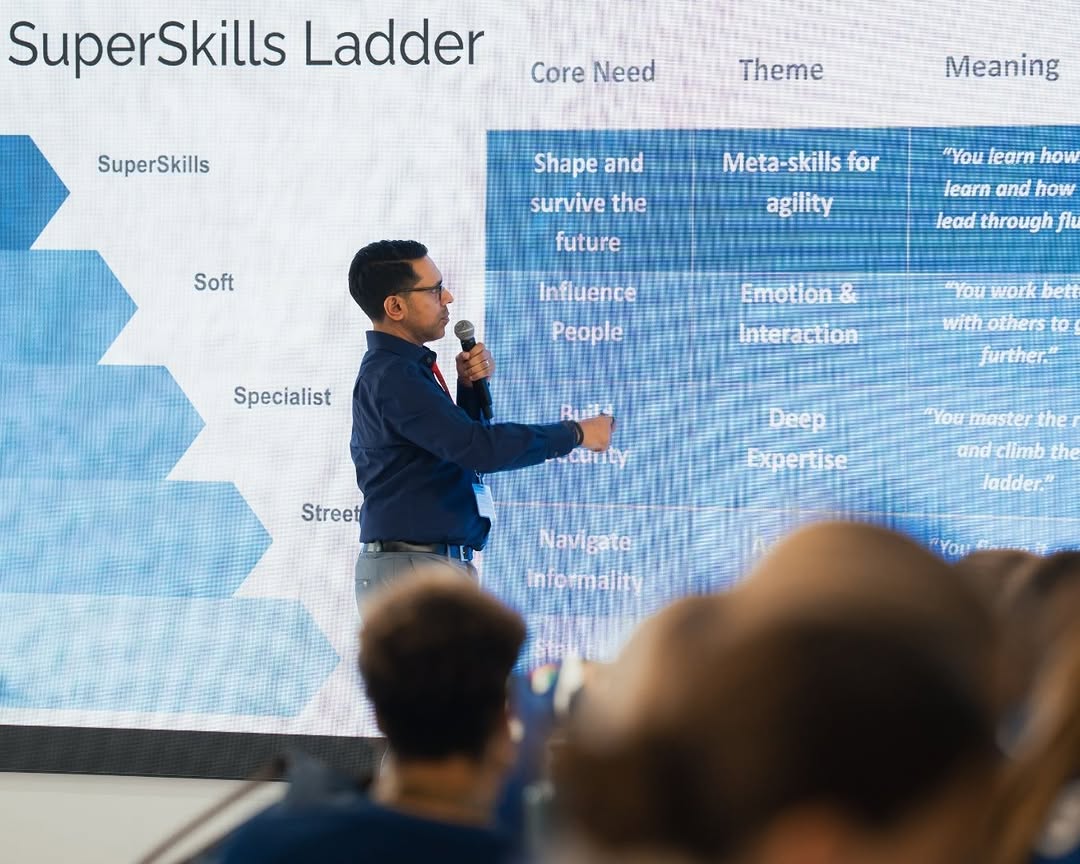
SuperSkills Ladder
The evolution from survival to human mastery.
Synthetic Data
Artificial data used when real data is limited.
Synthetic Seniority
The illusion of experience produced by AI answers.
System Prompt
Hidden instructions shaping behaviour.
T
Task Unbundling
Breaking roles into automatable and human tasks.
Temperature
Controls predictability versus creativity in outputs.
Technical Debt
Shortcuts that create long-term cost.
Token
The basic unit of text processed by language models.
Training Data
The examples a system learns from.
Transfer Learning
Applying learned patterns across domains.
Transformer
The architecture behind most modern language models.
Transparency
Ability to inspect system operation.
Trust Flywheel
Ownership and openness that compound trust.
Trust Scar
Lasting damage from breach.
U
Uncertainty Quantification
Measuring how confident a model is.
Undrift
Reclaiming authorship from automation.
Unlearning
Removing specific knowledge from a system.
V
Validation
Testing performance on unfamiliar data.
Vector
A numerical position in meaning-space.
W
Watermarking
Marking AI-generated content for provenance.
Weight
A learned value shaping outputs.
Wisdom Loop
Turning data into insight, then action.
Work-as-Design
Treating work as improvable, not fixed.
World Model
An internal representation of relationships.
“Who wrote your last decision?”
A diagnostic for authorship.
Z
Zero-Shot
Performing tasks without examples. Impressive, but fragile.
If this is what you are grappling with in your organisation, the fastest starting point is the Sprint.
Win hearts and minds with a Keynote
or Hire Rahim Hirji on Retainer
Rahim Hirji