
The Reading Compass: Complete Reference List of the Best 30 Books on AI
Companion resource to "The AI Reading Strategy That Turns Books Into Decisions" 30 titles mapped to quadrants, with author, year, and decision relevance
Assign by quadrant, not by personal interest. The goal is coverage, not consensus.
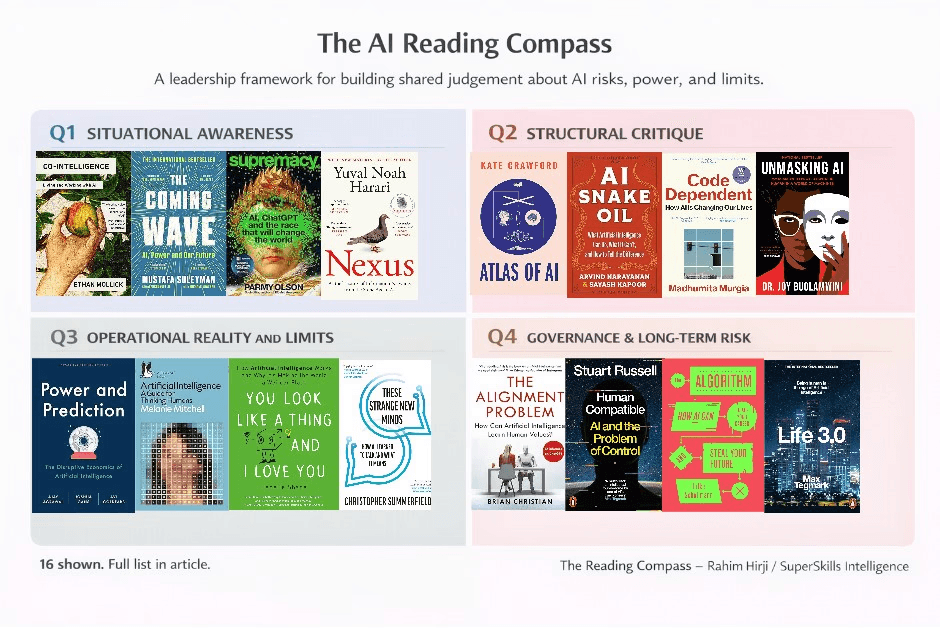
Quadrant 1 – Situational Awareness
What is happening, why now, and how should leaders frame it?
★ Co-Intelligence – Ethan Mollick (2024) Best for: Practical adoption decisions
The Coming Wave – Mustafa Suleyman with Michael Bhaskar (2023) Best for: Strategic framing of diffusion and containment
Supremacy – Parmy Olson (2024) Best for: Competitive dynamics and the AI race
Nexus – Yuval Noah Harari (2024) Best for: Board-level sensemaking and historical context
How to Think About AI – Richard Susskind (2025) Best for: Conceptual clarity for non-specialists
The Age of AI – Henry Kissinger, Eric Schmidt, Daniel Huttenlocher (2021) Best for: Geopolitics and elite strategic framing
AI Superpowers – Kai-Fu Lee (2018) Best for: US-China dynamics and national strategy
Chip War – Chris Miller (2022) Best for: Semiconductor geopolitics and AI infrastructure risk
Quadrant 2 – Structural Critique
Who pays the cost and where does power concentrate?
★ Atlas of AI – Kate Crawford (2021, updated 2025) Best for: AI as industrial system: labour, energy, power
AI Snake Oil – Arvind Narayanan & Sayash Kapoor (2024) Best for: Distinguishing real capability from vendor claims
Code Dependent – Madhumita Murgia (2024) Best for: Human impact and workforce consequences
Unmasking AI – Joy Buolamwini (2023) Best for: Bias in deployed systems
Blood in the Machine – Brian Merchant (2023) Best for: Historical context for labour and automation resistance
The Algorithm – Hilke Schellmann (2024) Best for: Hiring, surveillance, and automated management
Weapons of Math Destruction – Cathy O'Neil (2016) Best for: Opaque models and systemic inequality
Race After Technology – Ruha Benjamin (2019) Best for: Algorithmic racism and structural bias
Your Face Belongs to Us – Kashmir Hill (2023) Best for: Facial recognition, surveillance, and privacy
Quadrant 3 – Operational Reality and Limits
How does this actually work, what does it cost, and where does it break?
★ Power and Prediction – Ajay Agrawal, Joshua Gans, Avi Goldfarb (2022) Best for: Economic logic of AI-driven decisions
Artificial Intelligence: A Guide for Thinking Humans – Melanie Mitchell (2019) Best for: What AI can and cannot do
You Look Like a Thing and I Love You – Janelle Shane (2019) Best for: Intuition for failure modes
These Strange New Minds – Christopher Summerfield (2025) Best for: LLM capabilities and limits
AI 2041 – Kai-Fu Lee & Chen Qiufan (2021) Best for: Stress-testing near-term impacts without prediction theatre
Hello World – Hannah Fry (2018) Best for: Algorithmic systems in everyday life
Quadrant 4 – Governance and Long-Term Risk
What are the control problems and who is responsible? This quadrant informs policy, delegation boundaries, and escalation rules, not speculation.
★ The Alignment Problem – Brian Christian (2020) Best for: Why optimisation fails in the real world
Human Compatible – Stuart Russell (2019) Best for: The control problem explained clearly
The Algorithm – Hilke Schellmann (2024) Best for: Workplace governance and automated HR
Life 3.0 – Max Tegmark (2017) Best for: Long-run scenarios and governance choices
Superintelligence – Nick Bostrom (2014) Best for: Historically pivotal framing of existential risk
The Tech Coup – Marietje Schaake (2024) Best for: Democratic governance vs Big Tech power
Bonus reading: Situational Awareness: The Decade Ahead – Leopold Aschenbrenner (2024). A 165-page memo, not a traditional book, that became one of the most widely circulated AI documents of 2024 among policymakers and investors. Included for exposure to the most aggressive timeline currently influencing policy and defence conversations. Read for framing, not for forecasts. Available free at situational-awareness.ai.
Cross-quadrant note: Some books span multiple leadership needs. AI Snake Oil is listed under Structural Critique for its systemic analysis but is equally useful as Operational Reality pre-reading before any vendor evaluation. The Algorithm serves both Structural Critique and Governance. These Strange New Minds is listed under Q3 but also useful for Q1 framing. Assign based on the gap you are closing.
★ = Start-here pick for each quadrant
Rahim Hirji